
Georgia O’Keeffe: Style as Signature
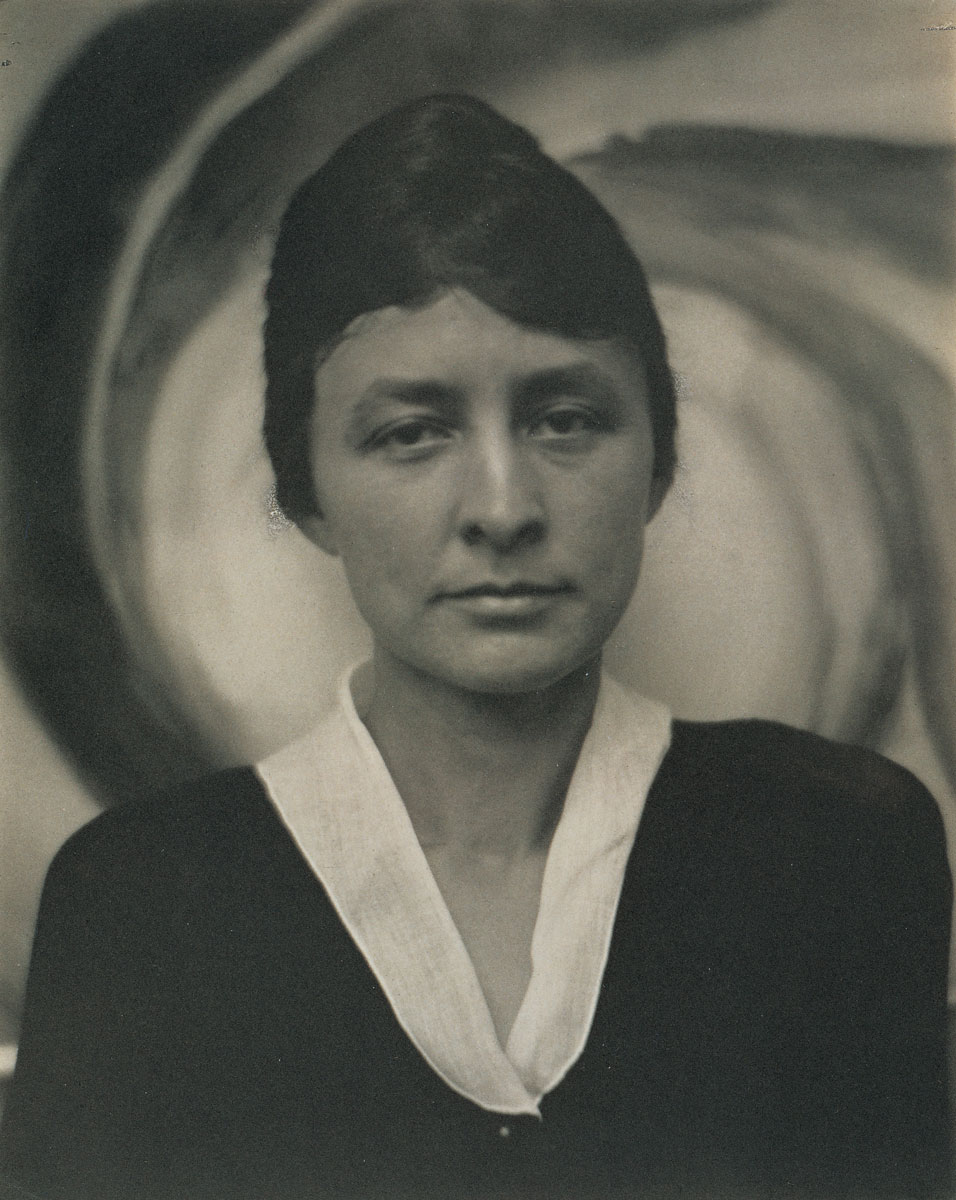
There exists a series of photographs of Georgia O’Keeffe in Abiquiú, in and around her New Mexico ranch, taken by Todd Webb, who captured her time and again. She appears with disarming simplicity – now standing before a cornfield, now beneath a shaded patio. She wears a black wrap dress, cinched at the waist, offset by a white V-neck collar; a brooch bearing her initials, designed by her friend, the sculptor Alexander Calder; lace-up shoes; her hair pulled tightly back. From one image to the next, the composition remains unchanged. A study in rigorous restraint.
And yet this look, fixed in images throughout the 1960s – decades before her death in 1986 – would prove enduring. “The image we have of her is always the same, regardless of the period in her life. We remember her dressed in black and white,” observed the historian Wanda Corn in a 2019 lecture on O’Keeffe’s style at Wichita State University. These photographs speak to a remarkable consistency in the way she dressed – constancy elevated to a form of discipline.
Even as a teenager, she stood apart. While the other girls styled their hair in elaborate Pompadour fashions and wore dresses with billowing sleeves and decorative bows, Georgia O’Keeffe startled with her “severity”.
Even as a teenager, at the Episcopal school she attended in Virginia, she stood apart. While the other girls styled their hair in elaborate Pompadour fashions – piled high and puffed up with ribbons – and wore dresses with billowing sleeves and decorative bows, Georgia O’Keeffe startled with her “severity”. Her hair was simply pulled back into a low tie, fastened with a single ribbon; her blouse, stripped of ornament. She stood out – she was barely sixteen or seventeen.
This restraint may also have had practical roots. Her clothes were often handmade. As Wanda Corn notes, the young O’Keeffe – the second of seven children raised on a farm – sewed her own garments with remarkable precision and control. The skill would later be immortalised by Alfred Stieglitz, her lover and gallerist, in the photograph Hands and Thimble (1919), where her hands take centre stage: one wearing a thimble, the other holding a needle.
No room for frills. And yet, make no mistake – it was already a statement. “Even in high school, she wanted to be different. She enjoyed not fitting the mould; she played with it,” says Marie Garraut, author of Georgia O’Keeffe, une icône américaine (Éditions Hazan). What she cultivated was an informed singularity – the kind that instinctively discerns between good taste and bad. “Her style stems as much from a form of modesty as from her upbringing, shaped by her mother – a Hungarian woman of aristocratic background, a model of independence – who was keen to instil in her daughters a sense of elegance,” the art historian continues.
Even in high school, she wanted to be different. She enjoyed not fitting the mould; she played with it.
Marie Garraut, author of Georgia O’Keeffe, une icône américaine
The result: from an early age, O’Keeffe developed a discerning eye for materials, favouring natural fabrics – linen, wool, cotton – over anything synthetic. Might this also suggest an early form of ecological awareness? Perhaps. What is certain is that, throughout her life, she displayed a marked sense of economy. She chose what she wore with care. “When she was young, she owned very few clothes, but they were always exceptionally well chosen. Later, as she began to earn a living from her work, around the age of thirty, she allowed herself a few designer pieces: a black suit by Cristóbal Balenciaga, Ferragamo shoes, or the loose, waistless dresses of Marimekko,” Garraut notes.
This desire for singularity never left her – quite the opposite. During her early years in New York, at the beginning of her relationship with Alfred Stieglitz, she asserted with unwavering confidence the style that would become her signature. “She always appeared rather eccentric in the way she dressed,” the historian observes. Her absence of colour, her almost androgynous appearance, her refusal of make-up – all stood in stark contrast, in the late 1910s, to social circles still steeped in Victorian fashion, with its corsets and elaborate hairstyles. “At the time, black was rarely worn, except in mourning,” notes the art and fashion historian Khémaïs Ben-Lakhdar.
If she could appear austere, even puritanical, Georgia O’Keeffe was in fact deeply aligned with avant-garde thinking. Like Coco Chanel, who freed the body from the constraints of the corset, O’Keeffe maintained a liberated relationship to her own body – something evident in the many portraits Alfred Stieglitz made of her. “She wanted to be able to move, and championed comfort. Clothes should adapt to the body’s movements, not the other way around,” Garraut adds. At the time, it was nothing short of radical.
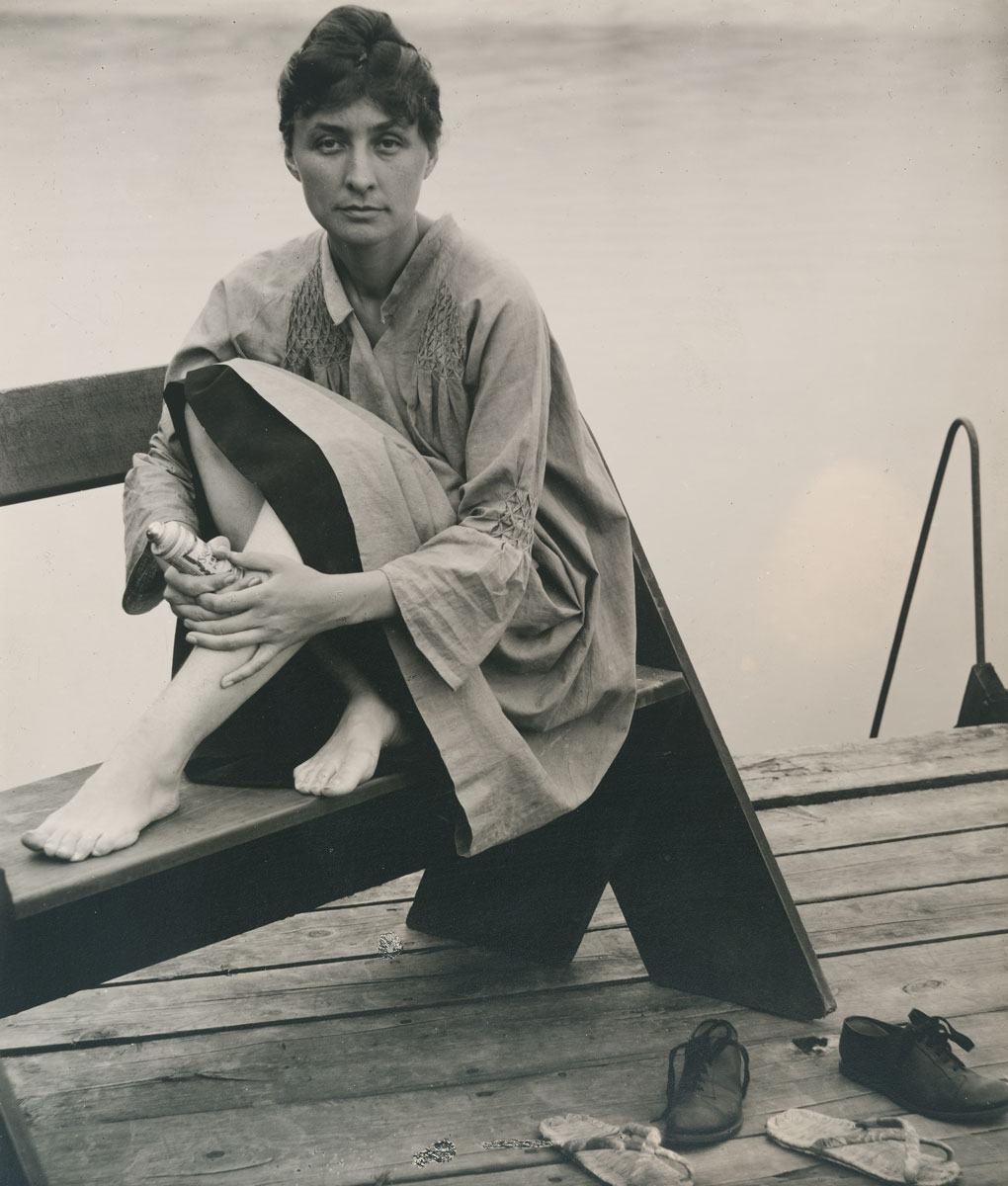
It was during this period that her artistic persona took shape – before Stieglitz’s lens. Clothed or unclothed, she played with her own construction as an icon. “Georgia’s body becomes a subject. The photographer captures a sensuality that seems to spill beyond the frame, even as it grows more enigmatic. He was fascinated by her ‘womanness’,” Wanda Corn observes.
This modern image – intense, unsmiling, rendered in black and white – was later reinforced by her move to New Mexico. Beginning in 1929, during her first trips West, she started wearing jeans, long before they entered the mainstream. “At the time, trousers implied the existence of an in-between – the legs – which was considered entirely improper for women. Wearing them in the 1920s and 1930s was a way of asserting oneself,” notes Khémaïs Ben-Lakhdar. While not overtly feminist in posture, O’Keeffe could not have been unaware of the significance of such a gesture.
In 1929, during her first trips West, she started wearing jeans, long before they entered the mainstream.
Jeans, still uncommon then, also carried a patriotic charge in the wake of the Great Depression. As the fashion historian points out, “Originally, before Levi’s opened its lines to women, they were a garment for male labourers. Jeans were a powerful, highly political symbol of American identity.” Once again, O’Keeffe was ahead of her time.
In Taos, and later in Abiquiú, at her ranch, she adopted a gaucho hat, bandanas tied at her neck or woven into her hair, and lightweight canvas sneakers. “Her style is a composite of different strata of American society,” says Marie Garraut. The painter freely blended elements borrowed from cowboys, Navajo traditions, even nuns – think those ample wrap dresses with narrow sleeves. “It has often been assumed, mistakenly, that she wore only kimonos, when in fact she also wore Claire McCardell’s ‘Popover’ Pyramid dress (the American designer behind the rise of ready-to-wear), created in 1951,” Wanda Corn notes.
With its ease and comfort, the dress became a staple of O’Keeffe’s wardrobe – a kind of uniform she adopted in multiple colours, much like her Ferragamo slippers.
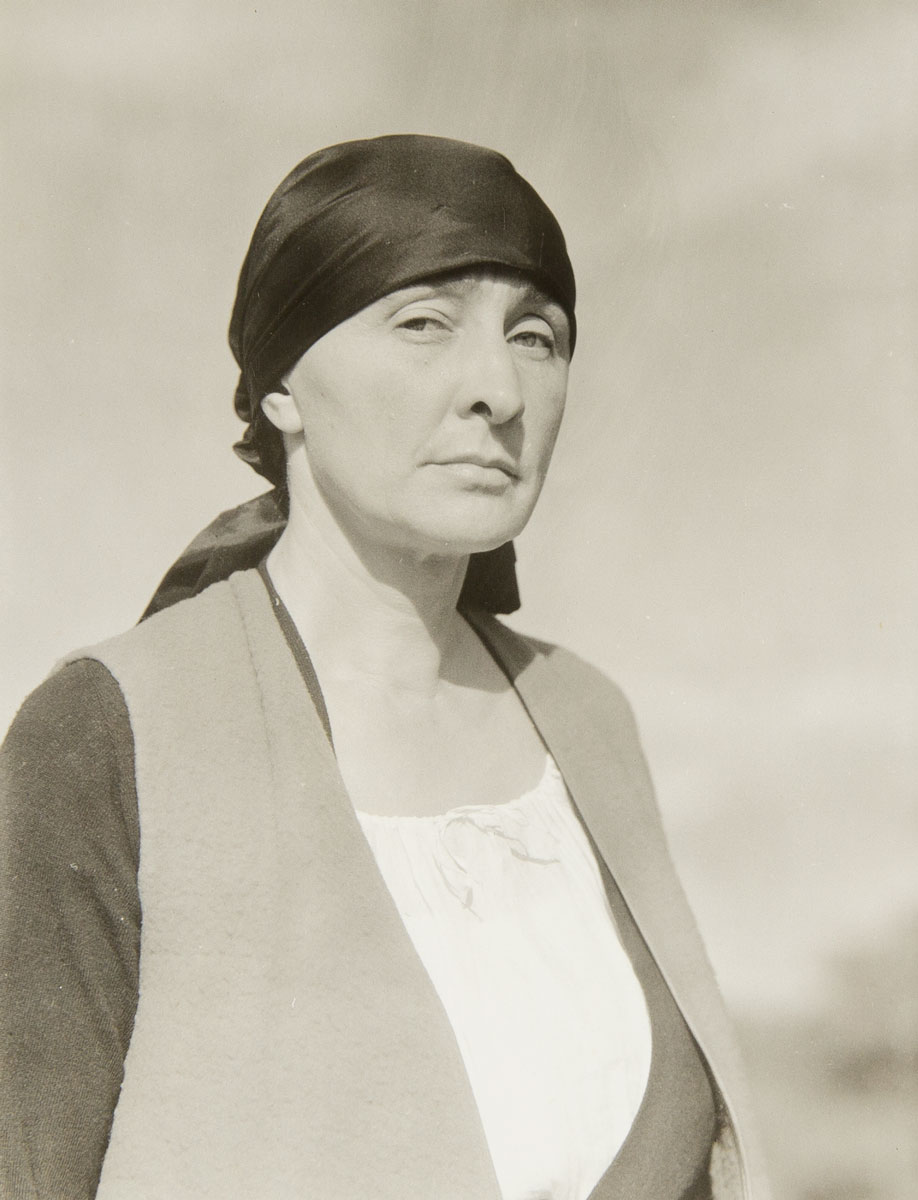
Fully aware of the power of silhouette, she cinched these dresses at the waist, shaping an hourglass figure. “She constructs a look that is perfectly attuned to her environment, mastering every detail to the point that she is never anything less than impeccably dressed,” Wanda Corn notes. Everything is controlled. Even when she opens the doors of her home – to leading fashion photographers as well as to local visitors documenting her life at Ghost Ranch – she carefully curates what is seen, increasingly embodying a sphinx-like figure: enigmatic, and closely aligned with Native American cultures. “She had an extraordinary physical presence, coupled with a natural aura made all the more striking by her economy of speech and way of life,” adds Marie Garraut.
Within this black-and-white silhouette – hair bound in a scarf, shaded by a gaucho hat – she came to embody an almost mystical, iconic figure, one that captivated photographers (from Andy Warhol to Bruce Weber) and inspired generations of designers.
Ahead of her time, she cultivated her own vegetable garden, embraced a rigorously healthy lifestyle, favoured fruits, vegetables, and local produce – and became known as much for her recipes as for her way of living.
Within this black-and-white silhouette – hair bound in a scarf, shaded by a gaucho hat – she came to embody an almost mystical, iconic figure, one that captivated photographers (from Andy Warhol to Bruce Weber) and inspired generations of designers. “Issey Miyake designed pieces with her in mind, and Calvin Klein travelled to her ranch to photograph her.” Though unwavering in her style, she continued – constantly, and in ever-renewed ways – to inspire creators around the world.
Her monastic aesthetic echoes in the work of Ann Demeulemeester, Yohji Yamamoto, The Row, and Rick Owens. Her fascination with skulls and roses resurfaces in Prabal Gurung’s 2012 prints. Her pared-back lines appear in Valentino, while her floral kaleidoscopes resonate in Givenchy under Riccardo Tisci. And one can only imagine that, following the Centre Pompidou retrospective, that list will continue to grow. ◼

Related articles
In the calendar
Georgia O’Keeffe in Abiquiú, New Mexico
Photo © Tony Vaccaro – Getty
Portrait of Georgia O’Keeffe at 291 Gallery by Alfred Stieglitz, 1917
Platinum-palladium print, 24 × 19 cm
© Georgia O’Keeffe Museum
Gift of the Georgia O’Keeffe Foundation
Portrait of Georgia O’Keeffe by Alfred Stieglitz, circa 1918–1919
Gelatin silver print, 22 × 19 cm
© Georgia O’Keeffe Museum
Portrait of Georgia O’Keeffe by Alfred Stieglitz, circa 1933
Gelatin silver print, 11.5 × 9 cm
© Georgia O’Keeffe Museum
Georgia O’Keeffe with her iconic gaucho hat, Black Place, New Mexico, 1963
Photo © Todd Webb