
Georgia O’Keeffe: The Pioneer Spirit

It took real nerve – along with unwavering confidence in her art – for a woman aligned with the avant-garde of the 1920s to dare to paint flowers. In doing so, she risked inviting every cliché of a deeply ingrained misogyny that relegated women to art seen as trivial, charming, and merely decorative. Georgia O’Keeffe refused to be constrained by such misreadings. In 1924, she launched a series of flower paintings that would become inseparable from her name. By then, she had already become what the American critic Henry McBride called “a newspaper personality” – what we would now describe as a media figure.
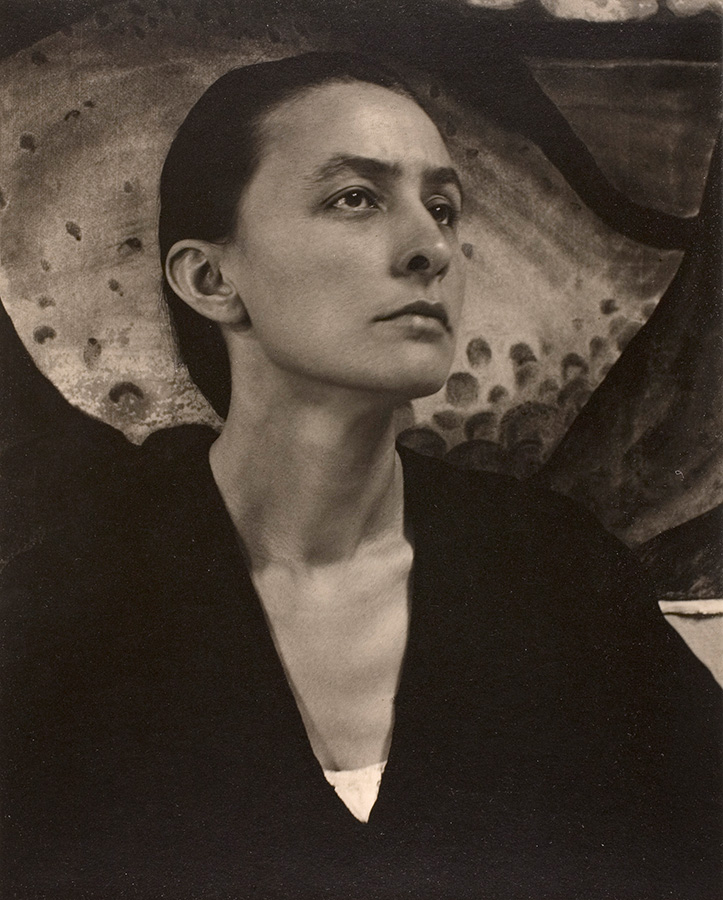
This fame had little to do with her art. It stemmed instead from an exhibition that, a few years earlier, had introduced New York audiences to Georgia’s unabashed nudity. The images were taken by the city’s most celebrated photographer: Alfred Stieglitz.
It took real nerve – along with unwavering confidence in her art – for a woman aligned with the avant-garde of the 1920s to dare to paint flowers.
In 1917, Stieglitz – founder of the 291 gallery and the man who, as early as 1905, had brought the European avant-garde (Matisse, Picasso, Brancusi…) to New York – was captivated by a series of drawings sent to him by a friend of an unknown young artist: Georgia O’Keeffe. His enthusiasm was such that he immediately displayed them on the walls of his gallery.
A year later, he orchestrated Georgia’s move to New York, providing her with both a place to live and the means to devote herself entirely to her work. What followed was a passionate love affair – and the photographic series that would first bring her into the public eye.
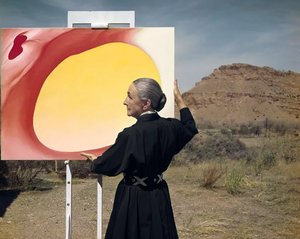
It took O’Keeffe remarkable self-assurance – and no small measure of physical courage – to decide, in the mid-1930s, to settle alone on an isolated ranch in New Mexico. Ever since discovering the landscapes around Taos, she had been convinced she had found the space and light that reconnected her with the sensations of her childhood on the plains of the Midwest, where she grew up in Sun Prairie, Wisconsin.
In New Mexico, she transposed into the mineral starkness of the landscape the same sensuality and erotic charge that had defined her flowers.
In New Mexico, she transposed into the mineral starkness of the landscape the same sensuality and erotic charge that had defined her flowers. In contact with Native American cultures – particularly Hopi and Zuni – she produced a body of work that revived the great pantheistic and Romantic spirit of early American landscape painting, that of the Hudson River School, from Albert Bierstadt to Thomas Cole and Thomas Moran.
Having been a pioneer of American modernism in the late 1910s, Georgia O’Keeffe’s painting – pushing simplification to its limits in forms drawn from her immediate surroundings, from the patio door of her home to the views glimpsed through airplane windows – anticipated, as early as the 1950s and 1960s, the explorations of a new generation of artists associated with so-called “hard-edge” and Minimalist art. ◼


- Georgia O’Keeffe, "Series I White & Blue Flower Shapes", 1919
- Georgia O’Keeffe, "Red, Yellow and Black Streak", 1924
- Georgia O’Keeffe, "The Shelton with Sunspots, N.Y.", 1926
- Georgia O'Keeffe, "Jimson Weed/White Flower No. 1", 1932
- Georgia O'Keeffe, "Winter Road I", 1963
Didier Ottinger, Deputy Director of the Musée National d’Art Moderne, has curated numerous landmark exhibitions, including “Magritte. La trahison des images” (2016), the retrospective David Hockney (2017), and “Bacon en toutes lettres” (2019).
Related articles
In the calendar
Georgia O’Keeffe, Red, Yellow and Black Streak, 1924
Oil on canvas, 101.3 × 81.3 cm
© Centre Pompidou / Photo: Ph. Migeat
Georgia O’Keeffe, Series I White & Blue Flower Shapes, 1919
Oil on panel, 50.5 × 40 cm
Georgia O’Keeffe Museum, Santa Fe
Gift of the Georgia O’Keeffe Foundation
© Courtesy Georgia O’Keeffe Museum / Photo: Tim Nighswander / Imaging4Art
© Georgia O’Keeffe Museum / ADAGP, Paris, 2021
Georgia O’Keeffe, The Shelton with Sunspots, N.Y., 1926
Oil on canvas, 123.2 × 76.8 cm
The Art Institute of Chicago, Illinois, United States
Gift of Leigh B. Block
© Art Institute of Chicago / Photo: Bridgeman Images
© Georgia O’Keeffe Museum / ADAGP, Paris, 2021
Georgia O’Keeffe, Jimson Weed / White Flower No. 1, 1932
Oil on canvas, 121.9 × 101.6 cm
Crystal Bridges Museum of American Art, Bentonville, Arkansas, United States
© Crystal Bridges Museum of American Art / Photo: Edward C. Robison III
© Georgia O’Keeffe Museum / ADAGP, Paris, 2021
Georgia O’Keeffe, Winter Road I, 1963
Oil on canvas, 55.9 × 45.7 cm
National Gallery of Art, Washington, D.C.
Gift of the Georgia O’Keeffe Foundation
© Board of Trustees, National Gallery of Art, Washington