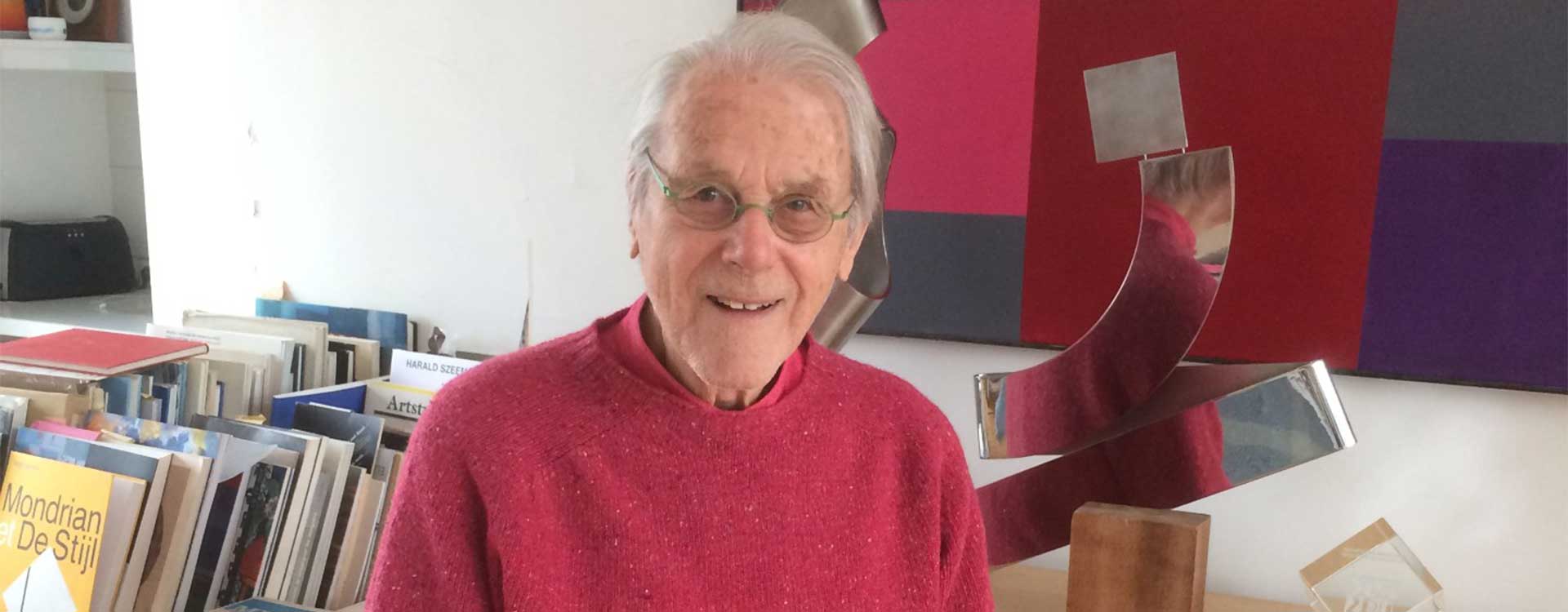
Jean Widmer: Putting Modernity into Action
You are part of the Swiss school of graphic design, which had a major influence on postwar France…
Jean Widmer — At the time, Switzerland was already deeply immersed in the formal research of the Bauhaus, unlike France, which was still recovering from the war. Together with Adrian Frutiger (the creator of numerous typefaces such as Univers and Frutiger, editor’s note), I studied at the same school of applied arts, the Kunstgewerbeschule in Zurich. Peter Knapp was there as well; he would later become the legendary artistic director of Elle magazine.
Our teacher, Johannes Itten, had taught at the Bauhaus before being forced out by Hitler in 1938. At first, I wasn’t necessarily planning to become a graphic designer. I came from a rural background – I grew up in the canton of Thurgau, near Lake Constance, at the foothills of the Alps. My grandfather worked on a farm and my father in a factory. But I had a good hand for drawing, which my high-school teacher noticed. My father didn’t quite know what to do with me, and my artistic leanings worried him.
Your first trip to Paris left a deep impression on you…
Jean Widmer — When I first arrived in Paris in 1953, just after graduating as a graphic designer, it was a shock. I immediately fell in love with the city. I breathed in its artistic atmosphere and thought, this is where I need to be. I decided to come back as quickly as possible. In France, unlike Switzerland, everything connected to everyday life was unattractive and not modern at all. There was work to be done! In 1953, I found an internship at Tolmer, a box-making company on the Île Saint-Louis. I designed decorative elements in the graphic studio, creating packaging for brands such as Elizabeth Arden.
You then went on to work in fashion…
Jean Widmer — In 1959, my former classmate Peter Knapp left to work at Elle magazine and suggested I take over his position as artistic director at Galeries Lafayette. It was already a major reference. I designed their logo at the time. Then, in 1961, I became artistic director of Jardin des modes magazine, where I worked with leading figures such as the photographer Helmut Newton.
My collaboration with the Centre Pompidou was a pivotal moment in my career […] For my 90th birthday last spring, they held a celebration on the building’s terrace. I was deeply honoured.
Jean Widmer
How did you come to work with the Centre Pompidou?
Jean Widmer — It was through Jardin des modes that I met François Barré, who was then director of the Centre de Création Industrielle (which would become one of the Centre Pompidou’s departments in 1973, editor’s note). He entrusted me with producing twenty posters for a series of exhibitions.
Barré introduced the very notion of design to France. At the time, France was still focused on the “decorative arts”, with their salons – it was the fashion of the day. Decorative design had its legitimacy, but that elegance was already somewhat outdated. The industrial designer Raymond Loewy had just published his book Ugly Sells Badly, and there was a wave to catch. Barré understood that this was the direction to take.
What memories do you have of your collaboration with the Centre Pompidou?
Jean Widmer — It was, of course, a pivotal moment in my career. Afterwards, I worked extensively with Jack Lang, François Mitterrand’s Minister of Culture. In particular, I designed the logos for the Musée d’Orsay and the Institut du Monde Arabe. The Centre Pompidou remains extremely important to me, and for my 90th birthday last spring, they organised a celebration on the building’s terrace. I was deeply honoured. ◼
[Translate to English:]
[Translate to English:]
Vous avez ensuite travaillé dans la mode…
JW — En 1959, mon camarade de promotion Peter Knapp part travailler au magazine Elle, et me propose de prendre sa suite au poste de directeur artistique des Galeries Lafayette. C’était déjà une référence très importante. J’ai conçu pour eux le logo de l’époque. Et puis, en 1961, je suis allé travailler comme directeur artistique pour le magazine Jardin des modes. J’y ai fait bosser des signatures comme le photographe Helmut Newton.
Ma collaboration avec le Centre Pompidou a été un moment pivot dans ma carrière […] Pour mes 90 ans au printemps dernier, ils ont fait une fête sur la terrasse du bâtiment, j’étais très honoré.
Jean Widmer
Comment en êtes-vous arrivé à travailler pour le Centre Pompidou ?
JW — C’est par Jardin des modes que j’ai rencontré François Barré, alors directeur du Centre de Création Industrielle (qui deviendra un des départements du Centre Pompidou en 1973, ndlr). Il m’a confié la réalisation de vingt affiches pour une série d’expositions. Barré a introduit la notion de design en France. À l’époque, on en était encore aux « arts décoratifs » en France, avec ses salons. C’était la mode. Le décoratif avait une raison d’être, mais cette élégance était quand même un peu dépassée. Le designer industriel Raymond Loewy venait de publier son livre La Laideur se vend mal, et il y avait une vague à saisir. Barré a compris qu’il fallait prendre ce courant.
Quel souvenir gardez-vous de votre collaboration avec le Centre Pompidou ?
JW — Ça a été évidemment un moment pivot dans ma carrière. Après, j’ai beaucoup travaillé avec Jack Lang, le ministre de la Culture de François Mitterrand. J’ai notamment dessiné les logos du musée d’Orsay ou de l’Institut du monde arabe. Le Centre Pompidou reste très important pour moi, et pour mes 90 ans au printemps dernier, ils ont fait une fête sur la terrasse du bâtiment, j’étais très honoré. ◼
Related articles

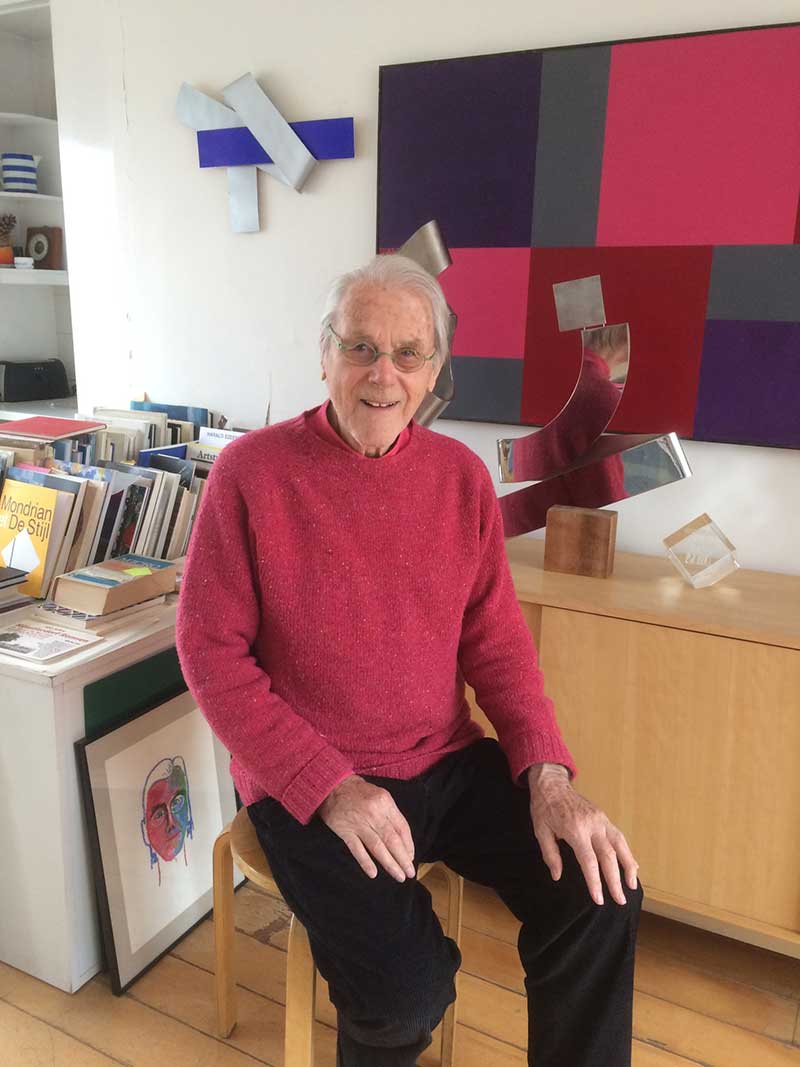
Jean Widmer at home in Paris, November 2019
Photo © Séverine Pierron