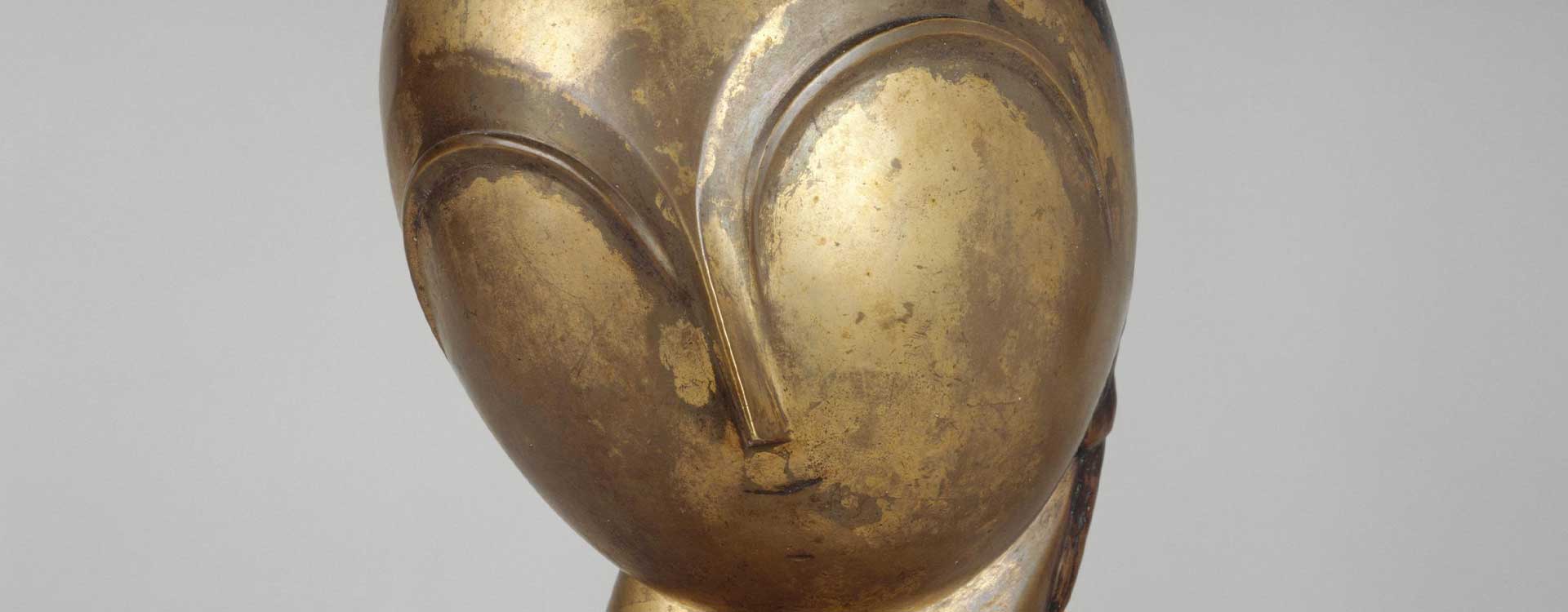
Focus on... « Danaïde » by Constantin Brancusi
In 1910–11, Constantin Brancusi (1876–1957) produced a series of studies of Margit Pogany, a young Hungarian artist he had met in a Paris boarding house. Pogany later recalled the encounter in a letter sent to the Museum of Modern Art in 1952 and published by Sidney Geist in Brancusi: A Study of the Sculpture. During her first visit to the artist’s studio on the Impasse Ronsin, in Paris’s 15th arrondissement, in July 1910, she noticed a head tilted on a slender neck, “all those big eyes”, which she took to be a portrait of herself drawn from memory. In fact, it was most likely Narcissus (1910), the alabaster sculpture with its inclined head and large bulging eyes rimmed with lids – features that would later reappear in the marble version of Mlle Pogany I, completed in 1912 after the sitter had left Paris.
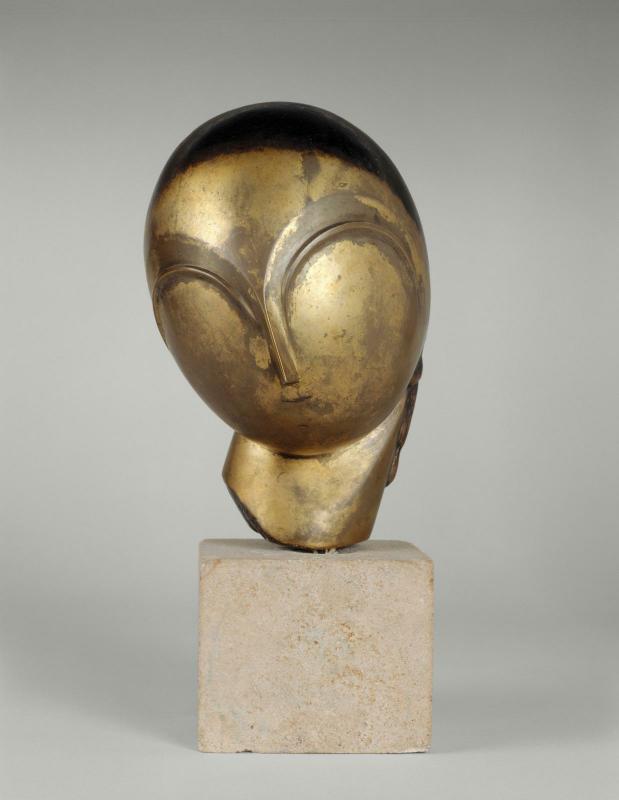
The first white marble version of Danaïde, exhibited in 1914 at Alfred Stieglitz’s Photo-Secession Gallery in New York, is a variation on Mlle Pogany – poised between the work’s first and second iterations – in which the prominent eyes give way to delicate semi-circular arcs. Much like Sleeping Muse and The Sleeping Child’s Head, both of which merge a face with an earlier sculptural form, Mlle Pogany emerged through a similarly serial process shaped by the presence of a model: Margit Pogany’s likeness gradually intertwining with those of Narcissus and, later, Danaïde.
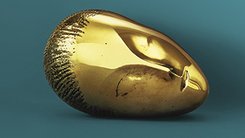
The contrast between the luminous gold of the face and the black patina of the hair lends the sculpture a meditative elegance and exquisite refinement evocative of East Asian Buddhist art.
Between 1913 and 1918, as though intent on exploring every possible variation of Danaïde, Brancusi produced multiple bronze casts – patinated, gilded or mirror-polished – preserving the memory of the marble original before it was ultimately reduced, after June 1922, to a pure abstract sphere. The first two casts, produced by the Parisian foundry Valsuani, including the example preserved in the artist’s bequest to the French State, were gilded with gold leaf. The contrast between the luminous gold of the face and the black patina of the hair lends the sculpture a meditative elegance and exquisite refinement evocative of the East Asian Buddhist art Brancusi so admired at the Musée Guimet. ◼
Excerpt from Modern Art Collection – The Centre Pompidou Collection, Musée national d’art moderne, edited by Brigitte Léal, Paris, Centre Pompidou, 2007.
Related articles

In the calendar
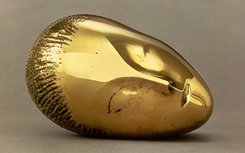
Constantin Brancusi, Danaïde (1913)
Bronze patiné noir (et doré à la feuille), pierre (calcaire)
27,5 x 18 x 20,3 cm
11,5 x 14 x 13,5 cm
© Succession Brancusi (Adagp)
© Centre Pompidou, Mnal-Cci/Dist. GrandPalaisRmn
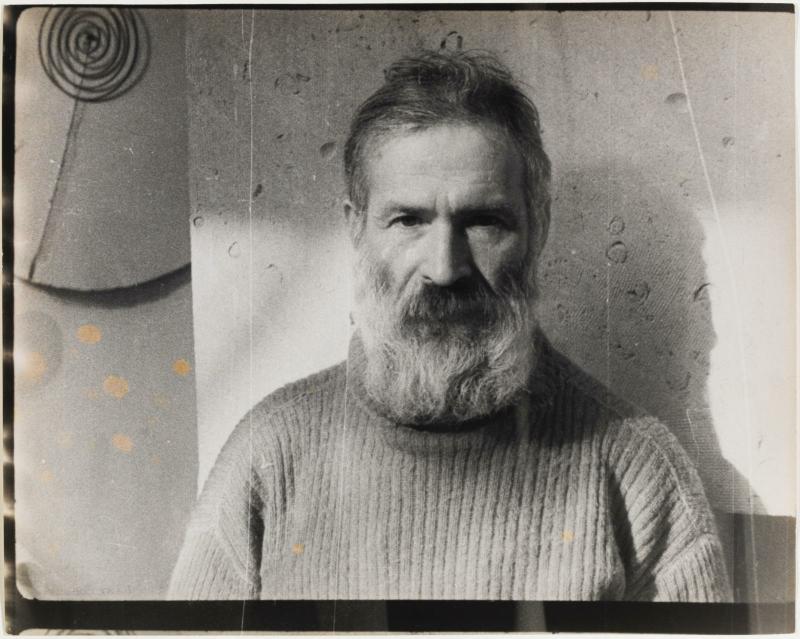
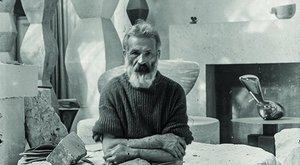
Portrait de Constantin Brancusi dans l'atelier, vers 1933-1934
Epreuve gélatino-argentique
23,8 x 29,9 cm
© Succession Brancusi (Adagp)
© Centre Pompidou, Mnam-Cci/Dist. GrandPalaisRmn