Focus on… « I See a Woman Crying… » by Rineke Dijkstra
Rineke Dijkstra (born 1959) is best known for her photographic portrait series featuring children, teenagers, young soldiers and young adults. Within the serial format and her characteristically rigorous aesthetic, the individuality of each sitter is set against a striking sense of vulnerability.
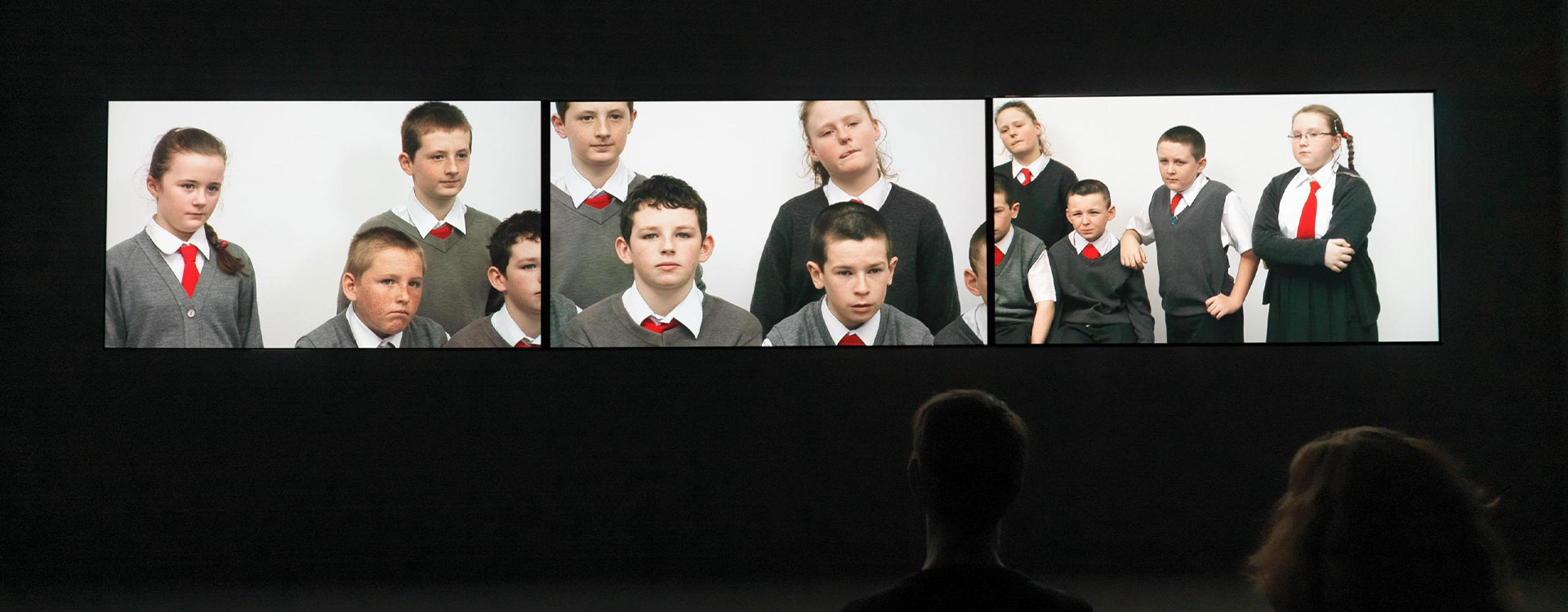
For this project, the Dutch artist was invited by Tate Liverpool to work with a group of schoolchildren. Drawing on the familiar ritual of school visits to museums, she set up her studio in the gallery spaces and, over the course of several days, used three cameras to film nine children arranged in a carefully composed formation. They engage in an animated discussion about a painting that remains unseen throughout the film and is identified only at the very end. Dijkstra subsequently edited and structured the footage.
Completely absorbed by the painting, the children reveal a range of emotions, from excitement to anxiety, from thoughtful silence to exuberant chatter.
Completely absorbed by the painting, the children reveal a range of emotions, from excitement to anxiety, from thoughtful silence to exuberant chatter. As they describe what they see, their imaginations often take flight. The painting in question is Pablo Picasso’s Weeping Woman (1937), a vividly coloured portrait of Dora Maar in tears.
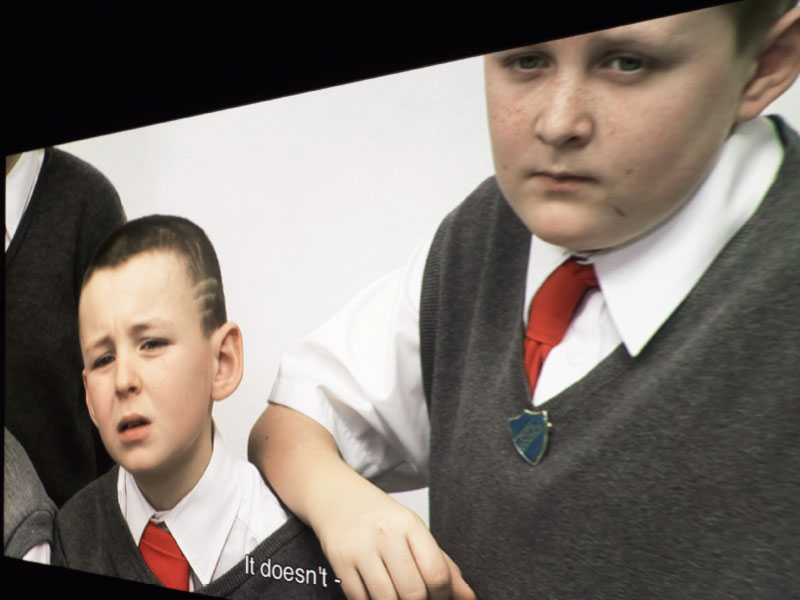
“I wanted to choose a somewhat abstract work that would be open to a range of interpretations,” recalls Rineke Dijkstra. The installation comprises three large-scale high-definition projections. Images and sound move from one screen to another; close-ups of the children’s faces alternate with wider shots in a carefully paced sequence, shaped by precise editing, meticulous sound design and a controlled rhythm. Arranged side by side in a panoramic configuration, the three screens immerse viewers in the unfolding discussion.
I wanted to choose a somewhat abstract work that would be open to a range of interpretations.
Rineke Dijkstra.
Dijkstra films the children with remarkable acuity and directness, patiently training her camera on their faces and expressions as they focus on a reproduction of the painting positioned out of view. The installation unfolds in four parts: first, a description of the painting and an introduction to Cubism; then an interpretation of the sitter’s emotional state; followed by reflections on the work’s context; and finally, a search for the artist’s intentions.
I See a Woman Crying can also be situated within a broader history of art criticism. The children’s observations remind us of the value of close looking, demonstrating how careful description can lead to a more universal understanding of art. As Dutch art historian Rudi Fuchs, former director of Amsterdam’s Stedelijk Museum, writes, “It is as if the installation were an instinctive translation of the painting itself.” ◼
Related articles



Rineke Dijkstra, I See a Woman Crying, Tate Liverpool, 2009 (2010)
Photo © Centre Pompidou
© Rineke Dijkstra