Jeanne Vicerial Turns Thread Into Sculpture
Straddling clothing, sculpture and scientific research, Jeanne Vicerial (b. 1991) has forged a singular, almost hypnotic body of work. Her black silhouettes — knotted, braided, organic — have made her one of the most sought-after artists working today. A sure sign of her ascent: in 2023, the Centre Pompidou acquired Mue (1/2) no. 3, a work featured in the exhibition Suivez le fil ! Design et textile at the Hôtel des arts in Toulon.
Jeanne Vicerial's black silhouettes — knotted, braided, organic — have made her one of the most sought-after artists working today.
Yet nothing in Vicerial’s early path pointed towards contemporary art. Hers has been an unconventional trajectory, taking her through fashion — including a stint with celebrated designer Hussein Chalayan — costume, and technical garment construction. That circuitous route is precisely what gives her work its distinctive character today. Her arresting sculptures still carry the memory of clothing, but now tell a different story: of the ways bodies are shaped, protected, constrained and repaired.
The body as a starting point
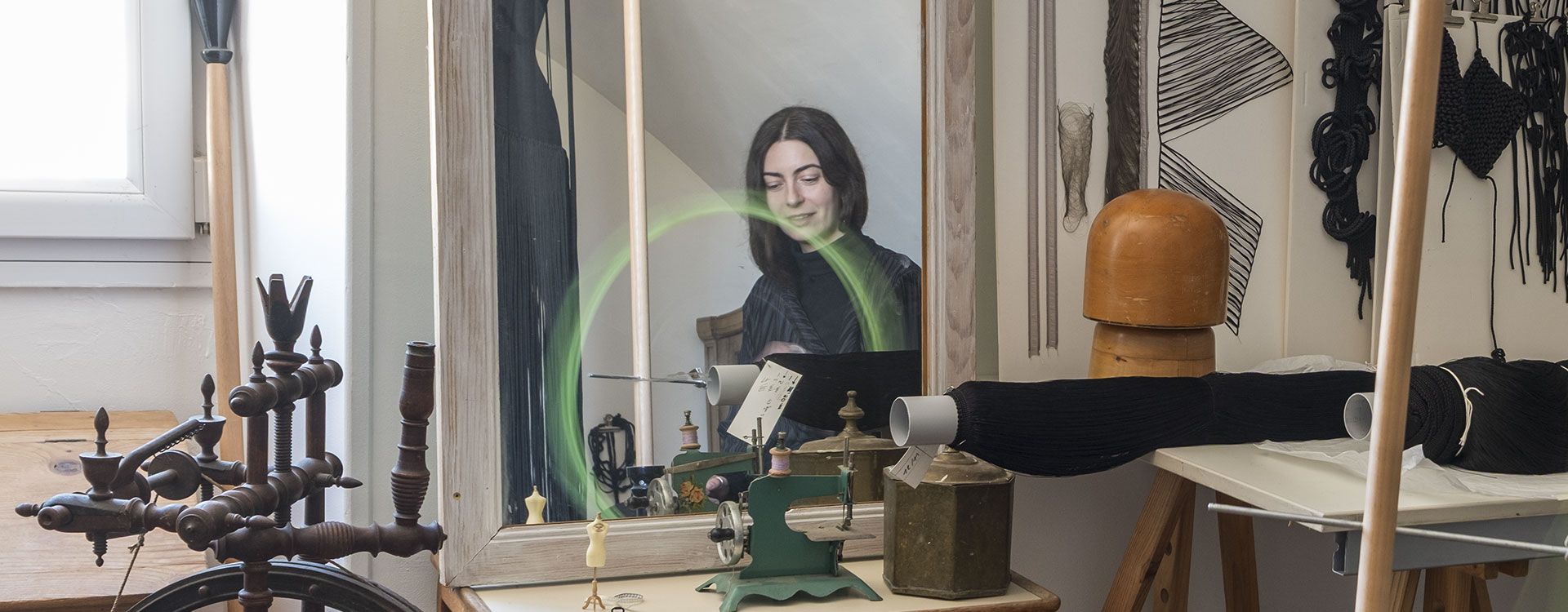
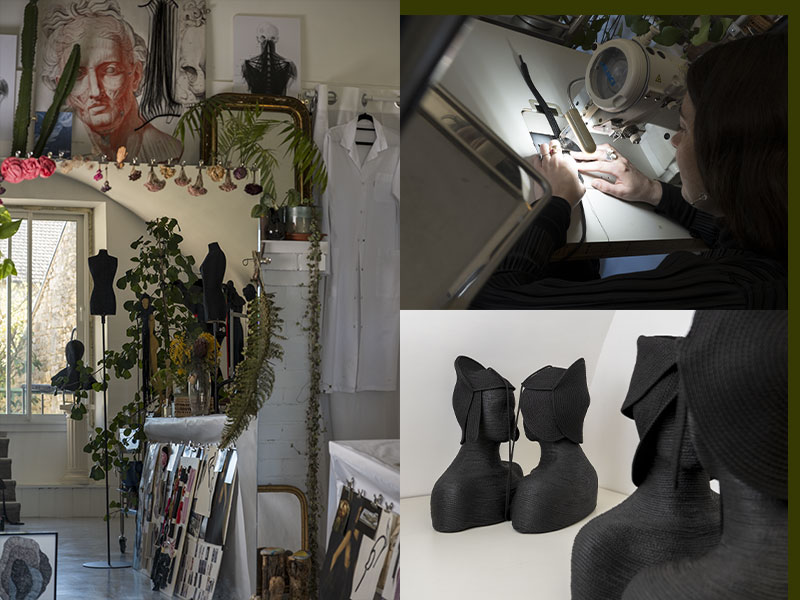
A few hours by train from Paris, Jeanne Vicerial welcomes us to her studio in a small village tucked into the Loue Valley, on the fringes of the Jura. Narrow lanes and weathered stone give the village a timeless feel. In an old house with a sprawling garden, her studio seems made for contemplation: a light-filled room lined with neatly stacked spools of thread, sewing machines, tools, mannequins, black cords and plants. Here and there, works in progress hover like half-formed human presences, lending the space an almost monastic stillness.
Set in an old house with a sprawling garden, her studio seems made for contemplation: a light-filled room lined with neatly stacked spools of thread, sewing machines, tools, mannequins, black cords and plants.
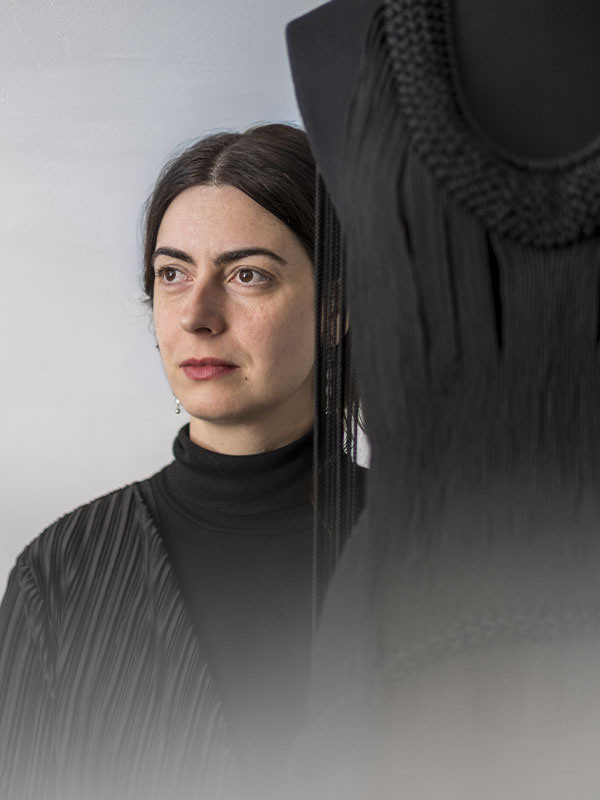
Soft-spoken and dressed, as she often is, in voluminous black, Vicerial moves effortlessly from childhood memories to reflections on the textile industry, weaving in questions of femininity, hybridit, and ecology along the way. As a child, she drew female figures and dreamed up imaginary collections of children’s clothes. She still has “tons of drawings” from those years, — and remembers wanting to become a costume designer. “I was fascinated by the way clothes could turn people into characters,” she recalls.
During the two years she spent earning her degree in crafts and design at the Lycée Paul-Poiret in Paris, Vicerial was introduced to a highly technical approach to clothing: made-to-measure construction, with the body as its exacting measure. “If you were off by two millimetres, you started over. It was incredibly hands-on, artisanal work.” She then went on to study fashion design at Paris’s École nationale supérieure des arts décoratifs (Ensad). “Suddenly I was working with mood boards. My two courses might as well have been a century apart: made-to-measure on one side, ready-to-wear on the other,” she says.
Why choose between them? “The Rana Plaza collapse was a turning point,” she says. In April 2013, when the building collapsed in Dhaka, Bangladesh, more than a thousand garment workers producing clothes for major Western brands in appalling conditions lost their lives. The disaster shocked the public and sent the industry into turmoil. “I began to seriously question my role as a designer, and whether I wanted to keep making clothes at all. The body became central to my thinking, alongside a growing sense that the fashion industry was profoundly broken.”
The body became central to my thinking, alongside a growing sense that the fashion industry was profoundly broken.
Jeanne Vicerial
Out of that reckoning came the Clinique vestimentaire in 2014: an intangible studio conceived as a hybrid space for research and experimentation, where clothing is no longer a fashion product but a living material conceived in relation to the human body. “A fictional, collective space where clothing could be imagined from the body itself: the skin, the spine, the weave of muscle.” Using spools of thread discarded by the textile industry, Vicerial began creating anatomy-inspired pieces from a single continuous thread, leaving no waste behind — works that resemble shed skins or wearable X-rays of the body.
Weaving in three dimensions
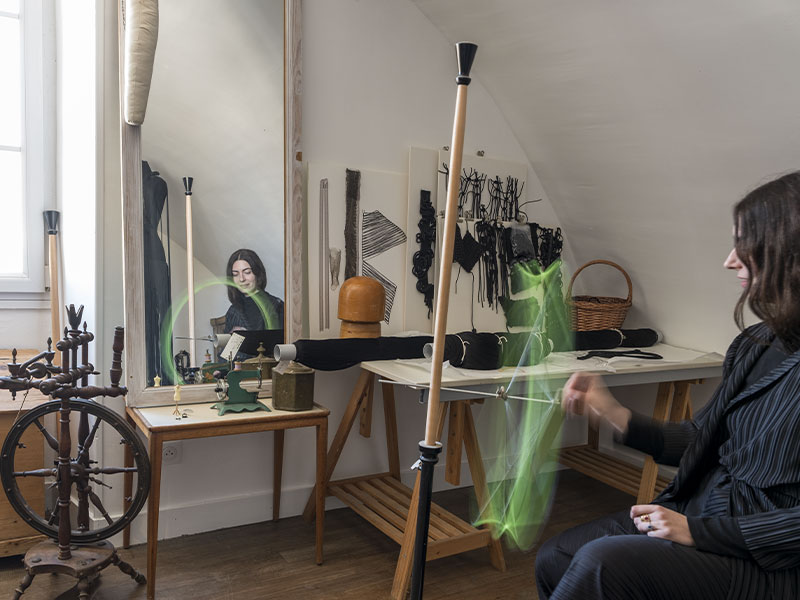
This is how “tricotissage” was born: using a single continuous thread, Vicerial draws forms in space, following the contours of the body without cutting the material or leaving any waste behind. Somewhere between knitting, lacework, and sculpture, the technique allows her to create made-to-measure pieces conceived as organic extensions of the body — an approach that brings ecological concerns and craftsmanship into a broader critique of industrial fashion. “This one is the Great Gladiator,” she says, pointing to one of her works. “I created his head from illustrations I found in old medical books. My father was an osteopath, so we had lots of diagrams of meridians around the house. I like bringing different ways of understanding medicine together.”
I draw in three dimensions.
Jeanne Vicerial
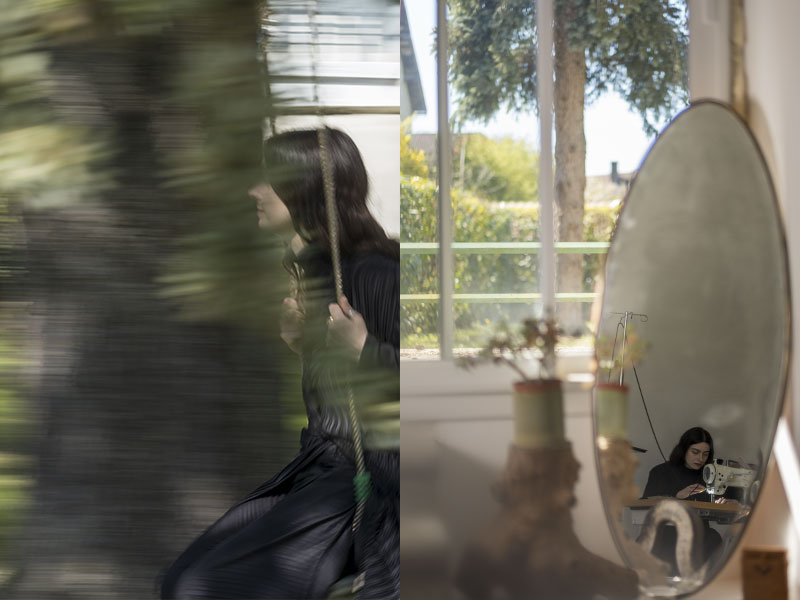
Vicerial even works with surgical needles and an IV stand, which allows her to construct her pieces in midair. “Really, I draw in three dimensions,” she says simply. The idea would become the subject of her PhD dissertation (École des mines, EnsadLab, in collaboration with the École normale supérieure), which she completed in 2019. As part of her research, she developed a machine capable of automating the process. “My prototype could do in seven minutes what used to take me seven hours by hand.”
The implications were significant: made-to-measure clothing could be produced locally, with no material waste — garments designed to adapt to the body itself. Vicerial calls it, with a smile, prêt-à-mesure, a play on prêt-à-porter and sur-mesure. The idea caught the attention of several manufacturers and ultimately led to a patent.
“What’s the point of making more clothes when we already have enough to dress ourselves for the next 300 years?” Vicerial says, disillusioned with the fashion industry’s relentless drive for profit. It is one of the world’s most polluting industries, producing some 100 billion garments a year, according to Ademe, France’s agency for ecological transition.
Beyond clothing
Long associated with women’s work and the domestic sphere, textile practices have historically been kept at the margins of fine art. Vicerial belongs to a generation of artists reclaiming these techniques and pushing them into the realms of sculpture, research, and installation. In 2020, at the height of the pandemic, she took up a residency at the Villa Medici in Rome, where she worked under the guidance of actress Tilda Swinton and fashion historian Olivier Saillard. It marked another decisive shift in her practice. “I wanted to work from the sculptures there, to study their muscles. I became interested in making armor for those Venuses with wet drapery, whose fabric always looks as though it just happened to fall that way.”
It gives me a way to explore everything — the body, fashion, women, art history — without having to make clothes. There’s a real freedom in that.
Jeanne Vicerial
Gradually, textile design and its industrial applications gave way to a more sculptural, experimental practice, one in which clothing becomes an exoskeleton. “It gives me a way to explore everything — the body, fashion, women, art history — without having to make clothes. There’s a real freedom in that.”
Vicerial has taken the reverse path of Madame Grès (1903–1993), the great couturière of the 1930s and one of her favourite artists. Grès had dreamed of becoming a sculptor, but was barred from studying at the Beaux-Arts because she was a woman. “Her dresses feel like true sculptures in drapery,” Vicerial says. At the time, even the Bauhaus, for all its professed commitment to gender equality, largely relegated women to the weaving workshop. Among the women associated with the avant-garde school were textile artist Anni Albers (1899–1994), designer Marianne Brandt (1893–1983) and photographer Lucia Moholy (1894–1989), all featured in the Centre Pompidou’s 2021 exhibition « Elles font l'abstraction ».
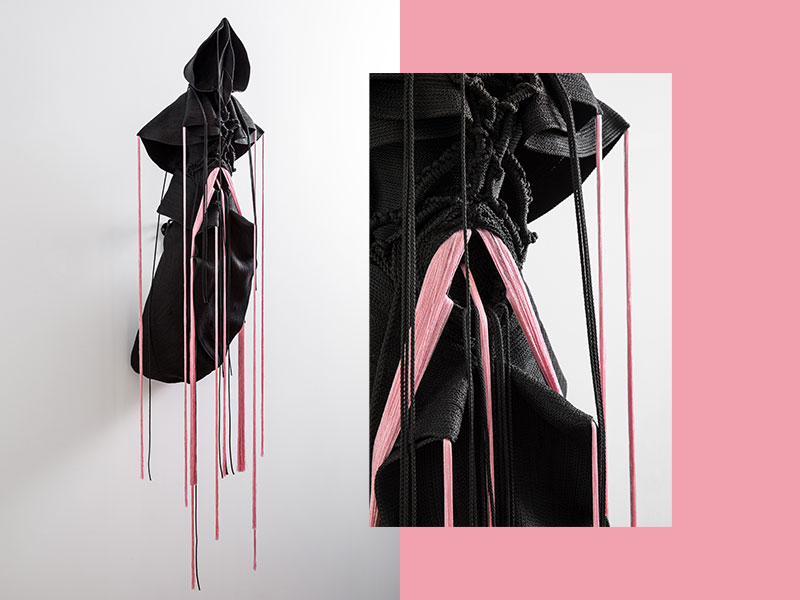
Some of Vicerial’s figures rise more than six feet tall, their long braids of recycled polyester trailing across the floor like funeral trains.
Over time, Vicerial’s works have grown more monumental — and more autonomous. Some of her figures rise more than six feet tall, their long swather of recycled polyester trailing across the floor like funeral trains. They were first shown at Galerie Templon in 2023, in the exhibition Armors. These looming presences suggest armor; others evoke shells or medieval tomb effigies.
I realized that black could become a material.
Jeanne Vicerial
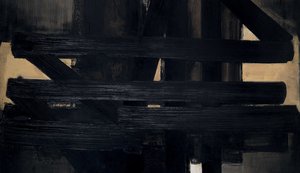
Black, a constant presence in her work, owes something to Pierre Soulages (1919–2022). “I realized that black could become a material,” she says, readily acknowledging a direct affinity with the painter, whose work she first encountered at the Centre Pompidou. There’s a hint of emotion in her voice as she mentions the Paris institution: “It was the first place I went when I arrived in Paris.” As for Soulages — a “towering figure in painting,” as she calls him — Vicerial paid tribute to him in the 2024 exhibition “Avant de voir le jour” at the Musée du Vieux Nîmes, where several of her pieces entered into dialogue with paintings by the recently deceased artist.
From her retreat in the Jura, the relentlessly prolific Vicerial continues to pursue an array of projects and collaborations. Moving between couture and the laboratory, anatomy and sculpture, she is patiently weaving a body of work all her own — one in which thread is no longer a means of dressing the world, but of reimagining it. ◼
Related articles

In the calendar
All images © Pierre Malherbet