Mathieu Pernot, the “Gadjo” Photographer
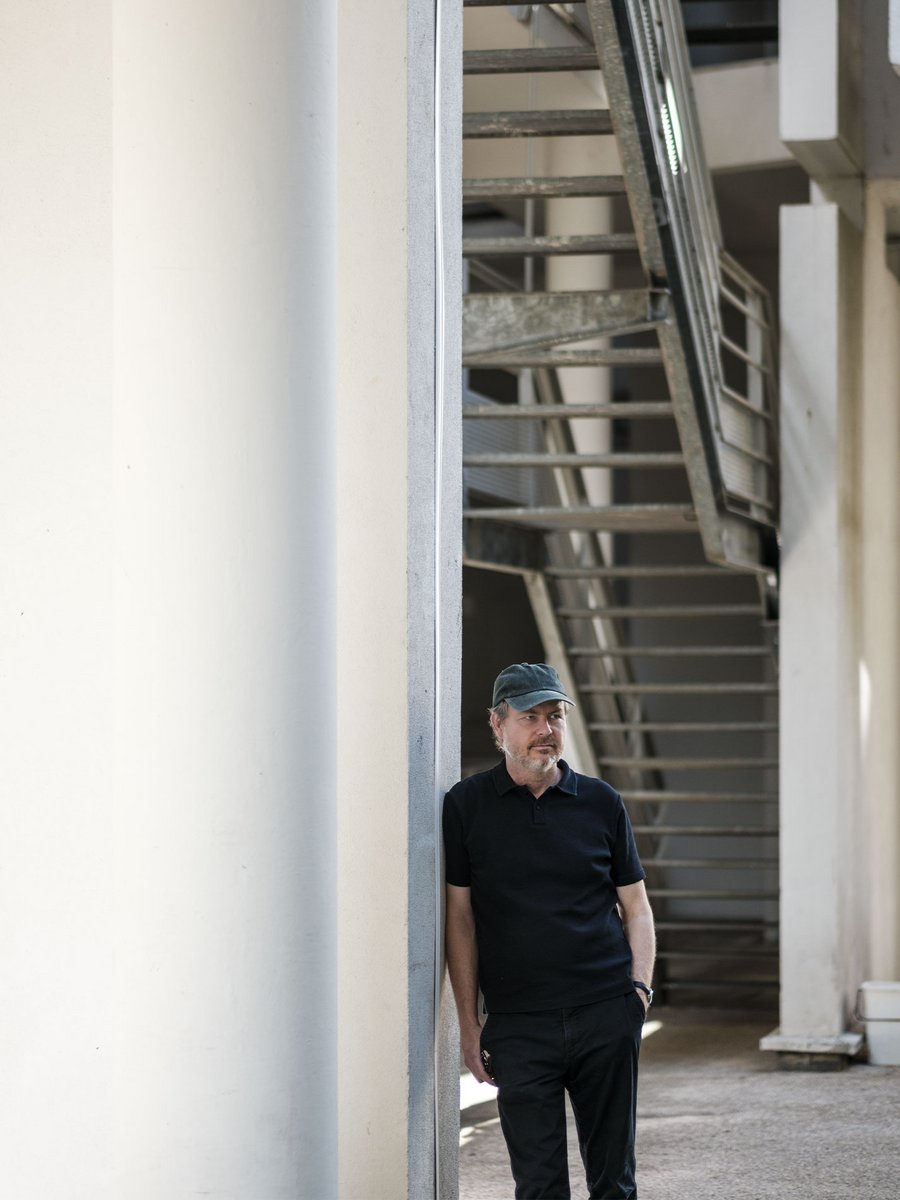
The summer heatwave beats down on the building where photographer Mathieu Pernot (born 1970) lives. Its vast geometric volumes of white concrete, designed by architect Michel Kagan, house artists’ studios whose neo-modernist inspiration could hardly be further removed from the ancient city of Arles, where it all began. It was there, in 1995, while studying at the École nationale supérieure de la photographie, a major institution in the Camargue capital, that Pernot first encountered the Gorgan family. This Roma family, whose caravans were parked between the SNCF freight station and the Rhône, has lived in France for more than a century. It marked the beginning of a long photographic journey. Since that first encounter, every member of the family, which has grown over the years, has continued to inhabit his photographs and share in his life.
Your story with the Gorgan family began in 1995. You were 24 and still a student in Arles …
Mathieu Pernot — I was intrigued by the presence of these families in the city, and I had noticed a site with caravans between the freight station and the banks of the Rhône. One day, I went there with my camera. But when I arrived, I felt ridiculous: I could hardly walk up to complete strangers and tell them I wanted to photograph them! So I carried on and sat down a little further along, by the river. A woman came over to read my palm. We started talking. I asked if I could take her portrait, and her children’s too. “Come to the site and ask my husband.” She was the one who invited me in. I took a few photographs and came back the next day to give them the prints. They asked me to take more. Then some of the families asked me to help them read official letters. That was how it all began, very simply, without any clear idea of what I wanted to do.

And that story has now been unfolding for more than thirty years …
Mathieu Pernot — Yes. Today, our relationship goes far beyond the photographic project. We speak regularly on the phone, and I go to see them without necessarily taking photographs. At a certain point, the bond becomes so strong that you grow close. Photography remains one of the driving forces behind our relationship, but it is by no means the only one anymore.
Has the way you photograph them changed over the years?
Mathieu Pernot — A great deal. Between 1995 and 1999, I photographed them and published a first book, Tsiganes, with Actes Sud. Then I moved to Paris in 2000 and, for about ten years, saw very little of them. When I returned to Arles around 2010, those I had left as children had become adults and had children of their own, some of whom were the same age their parents had been when I first met them. It was a profound shift. I realised that I now needed to show individual lives, rather than simply photograph a community. That is why the work subsequently became Les Gorgan. Each series bears the first name of an individual: Vanessa, Johnny … I make no claim to encapsulate an entire community. I tell the stories of the individual paths taken by the members of one family.
You photograph not so much “the margins” as fragility. What distinction do you draw between the two?
Mathieu Pernot — I was raised by parents who were sensitive to those who did not have the same opportunities as we did. That concern for others has always been part of who I am. But in photography, I would indeed speak more of fragility than of marginality. When I am confronted with something fragile, something that may disappear or whose existence is under threat — whether a person or a building — I feel something particular. That fragility creates a singular presence that interests me.
Does the camera allow you to get closer to others?
Mathieu Pernot — Mine certainly has brought me closer to them. I often wonder what my life would have been like if I had not become a photographer. Photography has allowed me to encounter worlds and places I would never otherwise have known. I hope it also allows viewers to come closer to worlds they know little about. That said, I do not try to create the impression that we are completely immersed in what I photograph. A certain distance always remains. But perhaps it is precisely this distance that allows us to see things as they are, without judgement.
Your work combines your own photographs with archival material and images produced by other devices. Why bring together so many different points of view?
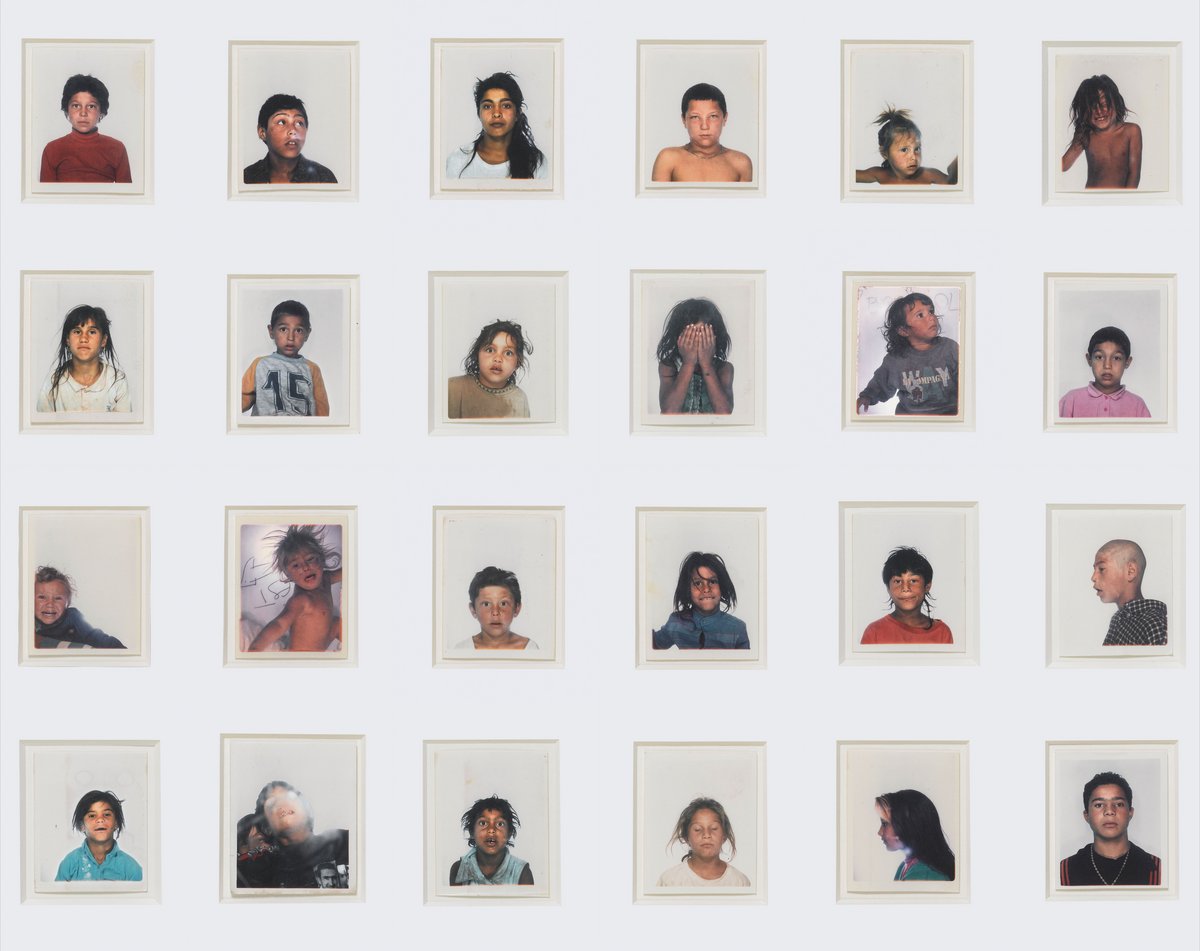
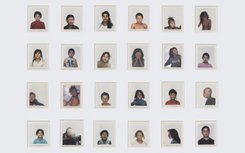
Mathieu Pernot — It began very early on, with the Gorgan family, in fact. Near the site where they lived, at Arles railway station, there was a photo booth. Faced with the sheer density of life around me, I was acutely aware of how little I understood what I was photographing. I realised that I needed to avoid limiting myself to a single point of view. So I brought some of the children to have their pictures taken in the photo booth. The identity photograph is a highly restrictive, almost confining, format and I found it interesting to see what it produced with children whose lives, by contrast, fell outside many established social frameworks. One day, one of them grabbed hold of the bar inside the booth and started spinning around. His body completely subverted the constraints of the device. Another time, Priscillia entered the booth with her face hidden. I photographed her from the outside at the very moment the photo booth was photographing her from within. So we had two images of the same gesture, at the same instant, yet they were completely different. It raised a very simple question: what is an image? It is a point of view. And where we stand shapes that point of view.
Photographing people in vulnerable situations inevitably raises the question of the photographer’s position. Have you developed any rules over the years?
Mathieu Pernot — In fact, I do not believe there can be any general rule. Every situation is different. I continue to say that I do not know, and that with every new encounter, something new takes place. For some projects involving migrants, for example, I asked them to undertake a genuine piece of writing. I gave them notebooks and asked them to tell a story in their own language. I paid them by the page because I considered that they were doing work for me. In other situations, that approach would not have worked. On Lesbos, for example, payment would have created relationships that were too complicated. I would meet people, we would talk, sometimes exchange WhatsApp contact details, and then I would ask whether they would agree to be photographed. There is no rule. You simply have to remain aware of these questions and try, each time, to find the fairest possible approach.
Does this reflection also extend to the way the works subsequently circulate?
Mathieu Pernot — Yes. Two Afghans I worked with, Jawad and Mansour, had written texts that became a work, Les Cahiers afghans. When it was acquired by the Musée national de l’histoire de l’immigration, we had to decide how to share the proceeds. We chose to divide them between the gallery, Jawad and Mansour, and myself. These are always complex questions. You have to devise solutions as best you can, rather than turn away from the problem.
What makes a good photograph, in your view?
Mathieu Pernot — I am not entirely sure what a “good image” is. I anticipate a great many things, but what really grips me is reality itself. I see something and experience a kind of recognition: I perceive the potential image in what is before me. I am not particularly interested in the idea of the iconic image that says everything on its own. My photographs tend instead to belong to larger bodies of work, to series. That is also why I am so interested in the idea of montage, particularly in the form of atlases, such as Aby Warburg’s Mnemosyne Atlas.
You now have more than thirty years’ perspective on your first encounter with the Gorgan family. How do you look back on the 24-year-old who set out, camera in hand, to meet people he did not know?
Mathieu Pernot — I do not regret having been that young man. Today, I sometimes meet young photographers who very quickly impose all kinds of restrictions on themselves: do I have the right to approach this person? Am I entitled to photograph this particular world? I think it is a shame to give up on reaching out to others. Obviously, this does not mean approaching them like a predator, taking what you want and leaving. It means trying to imagine what you might create together. For me, photography is precisely the medium in which you cannot do without the people you represent. So should we refrain from representing others on principle, or take the risk of trying to do the best we can? I do not regret having taken that risk. That encounter allowed me to build a wonderful relationship with this family. For that alone, photography has already achieved something. ◼
Related articles
In the calendar
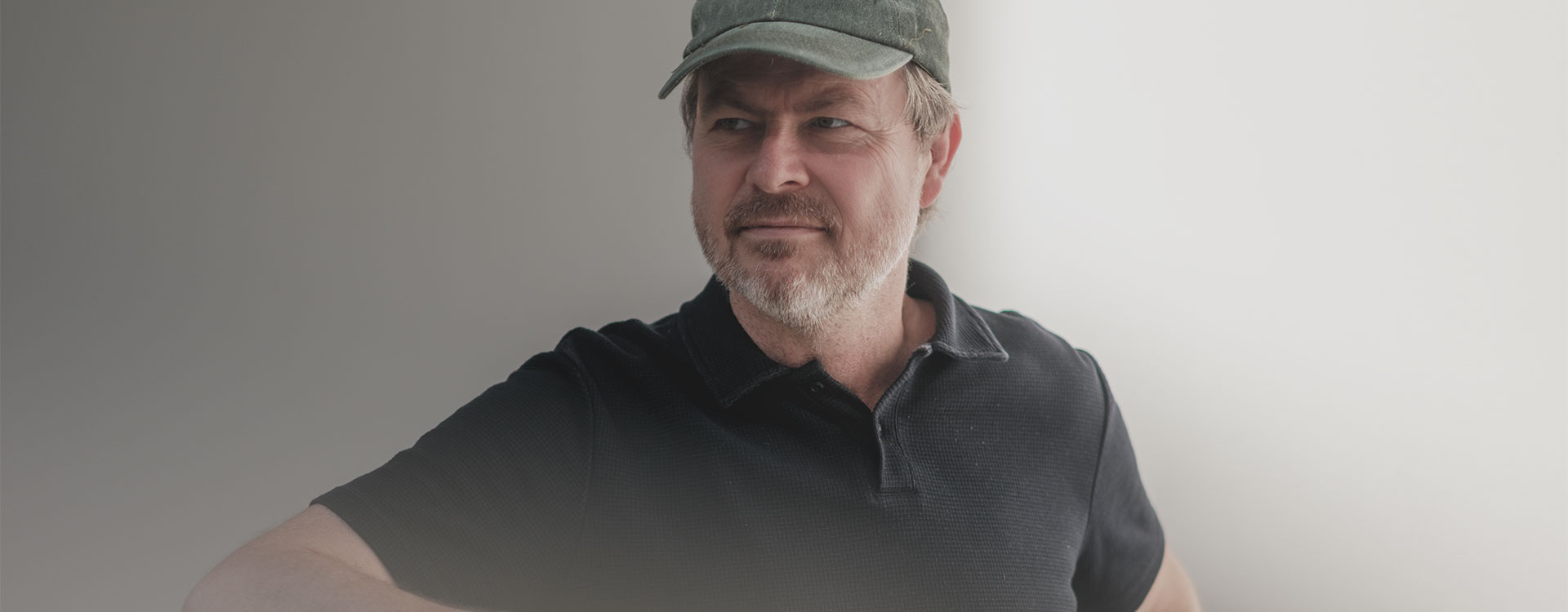
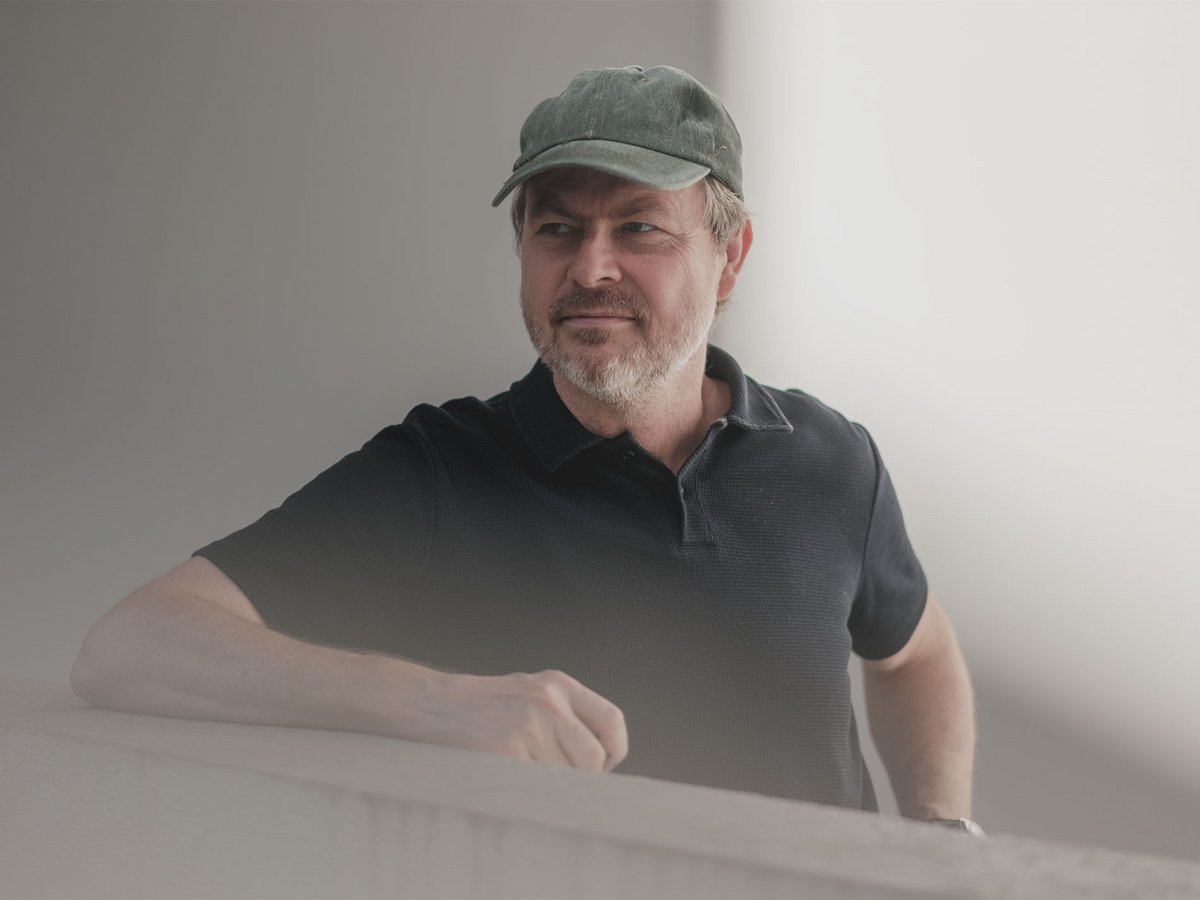
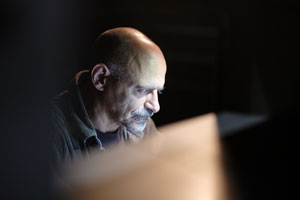
Portraits of Mathieu Pernot © Pierre Malherbet
Mathieu Pernot, Priscilla, Cabine du photomaton, 1995
gelatin silver print, 190 × 67 cm
Mathieu Pernot, Photomatons, 1995–1997
chromogenic print, photo booth photographs, 4.8 × 4 cm each
Centre Pompidou Collection © Adagp, Paris, 2026
Photo © Centre Pompidou / Dist. GrandPalaisRmn