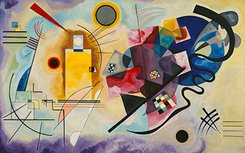
Gelb-Rot-Blau (Jaune-rouge-bleu)
1925

Gelb-Rot-Blau
(Jaune-rouge-bleu)
1925
Kandinsky started teaching at the Bauhaus in 1922. It was there he theorized his conception of art in the book Point and Line to Plane, of which Gelb, Rot, Blau might be said to be a visual illustration. Kandinsky’s early, lyrical and spontaneous abstraction gave way in the 1920s to one more geometric and rational. This painting is based on the equilibrium of opposing but contradictory elements. At first glance, there seem to be two contrasting parts, with geometric lines and luminous colours to the left, more complex forms and darker shades to the right. Yet the main emphasis is on the three primary colours, the composition being organised by their succession from left to right.
| Domain | Peinture |
|---|---|
| Techniques | Huile sur toile |
| Dimensions | 128 x 201,5 cm |
| Acquisition | Donation de Nina Kandinsky en 1976 |
| Inventory no. | AM 1976-856 |
Currently at
Palazzo Bonaparte, Rome (Italie)
as part of Kandinsky, 15 September 2026 - 14 February 2027
See on the Centre Pompidou's loan map in France and worldwide

Detailed description
| Artist |
Vassily Kandinsky
(1866, Empire Russe - 1944, France) |
|---|---|
| Main title | Gelb-Rot-Blau (Jaune-rouge-bleu) |
| Creation date | 1925 |
| Place of production | Weimar, mars - mai |
| Domain | Peinture |
| Techniques | Huile sur toile |
| Dimensions | 128 x 201,5 cm |
| Inscriptions | MO.D.B.G. : VK 25 |
| Acquisition | Donation de Nina Kandinsky en 1976 |
| Collection area | Arts Plastiques - Moderne |
| Inventory no. | AM 1976-856 |






Events
Bibliography
Roethel (H.K.), Benjamin (J.K.). - Kandinsky. Catalogue raisonné de l''oeuvre peint 1900-1915 (volume 1), 1916-1944. - Paris : Flinker, 1982-1983 (cat. n° 757 cit. p. 709 et reprod. coul. p. 711)
Kandinsky : Russian and Bauhaus years 1915 - 1933 : New York, The Solomon R. Guggenheim Museum, 9 décembre 1983-12 février 1984 // Atlanta, High Museum, 15 mars-29 avril 1984 // Zürich, Kunsthaus, 30 mai-15 juillet 1984 // Berlin, Bauhaus Archiv, 9 août-23 septembre 1984 .- New York : Solomon R. Guggenheim Foundation, 1983 (cat. n° 196 cit. p. 63-64, 66 et reprod. coul. p. 243)
Kandinsky : Russian and Bauhaus Years, 1915-1933 : New York, Solomon R. Guggenheim Museum, 1983 (cat. n° 196 cit. p. 63-64, 66 et reprod. coul. p. 243)
ROETHEL (Hans K.) et BENJAMIN (Jean K.). - Kandinsky. Catalogue raisonné de l''oeuvre peint. Deuxième volume 1916-1944. - Paris : éd. Karl Klinker, 1984 (cat. n° 757 cit. p. 709 et reprod. coul. p. 711) . N° isbn 2-900971-00-4
Voir la notice sur le portail de la Bibliothèque Kandinsky
Kandinsky : oeuvres de Vassily Kandinsky (1866-1944), Collections du Musée national d''art moderne : Paris, Centre Georges Pompidou, 30 octobre 1984-28 janvier 1985 / sous la dir. de Christian Derouet et Jessica Boissel (cat. n° 331 cit. et reprod. coul. p. 278-279) . N° isbn 2-85850-262-5
Voir la notice sur le portail de la Bibliothèque Kandinsky
La Collection du Musée national d''art moderne. Catalogue établi par la Conservation du Musée. - Paris : éd. du Centre Pompidou, 1986 / rééd. 1987 (sous la dir. d''Agnès de la Beaumelle et Nadine Pouillon) (cit. p. 303-304 et reprod. coul. p. 303) . N° isbn 2-85850-292-7
Voir la notice sur le portail de la Bibliothèque Kandinsky
Kandinsky : Moscou, Galerie Tretyakov, 24 avril-11 juin 1989 (cat. n° 54 p. 255)
Marotta (Anna).- Policroma : dalle teorie comparate al progetto del colore.- Turin : Celid, 1999 (cit. et reprod. coul. p. 75) . N° isbn 88-7661-369-2
Voir la notice sur le portail de la Bibliothèque Kandinsky
Kandinsky : Paris, Centre Pompidou, 8 avril-10 août 2009 / sous la dir. de Christian Derouet. - Paris : éditions du Centre Pompidou, 2009 (cit. et reprod. coul. p. 156-157 (légende p. 359)) . N° isbn 978-2-84426-381-0
Voir la notice sur le portail de la Bibliothèque Kandinsky
Modernités plurielles, 1905-1970 dans les collections du Musée national d''art moderne : Paris, Musée national d''art moderne, Centre Pompidou, 23 octobre 2013-26 janvier 2015. - Paris : éd. Centre Pompidou, 2013 (sous la dir. de Catherine Grenier) (reprod. coul. p. 76) . N° isbn 978-2-84426-622-4
Voir la notice sur le portail de la Bibliothèque Kandinsky
Vassily Kandinsky. La collezione del Centre Pompidou : Milan, Palazzo Reale, 17 décembre 2013-27 avril 2014.- Milan, 24 ORE Cultura, 2013 (sous la dir. d''Angela Lampe) (cat. n° 69 cit. p. 26, 39, 121, 154, 198 et reprod. coul. p. 155 (détail), 156-157) . N° isbn 9788866481669
Voir la notice sur le portail de la Bibliothèque Kandinsky
Kandinsky. A retrospective : Milwaukee Art Museum, 5 juin-1er sept. 2014 // Nashville, The First Center for the Visual Arts, 26 sept. 2014-4 janv. 2015.- Paris, Ed. du Centre Pompidou / Milwaukee Art Museum, 2014 (sous la dir. d''Angela Lampe et Brady Roberts) (cat. n° 92 cit. p. 118, 122, 140 et reprod. coul. p. 141) . N° isbn 978-0-300-20663-0
Voir la notice sur le portail de la Bibliothèque Kandinsky
Kandinsky. Una retrospectiva : Madrid, Centrocentro Cibeles, 20 octobre-28 février 2016.- Madrid, ed. Palacios y Museos, 2015 (cat. n° 71 cit. p. 149, 222-223 et reprod. coul. p. 150-151) . N° isbn 978-84-8003-991-8
Voir la notice sur le portail de la Bibliothèque Kandinsky
Musicircus : oeuvres phares du Centre Pompidou : Centre Pompidou-Metz, 20 avril 2016 -17 juillet 2017 / sous la dir. d''Anne Horvarth et Emma Lavigne. - Metz : Centre Pompidou-Metz, 2016 (cat. n°1 cit. p. 26 et reprod. coul. p. 33) . N° isbn 978-2-35983-042-2
Voir la notice sur le portail de la Bibliothèque Kandinsky
L''esprit du Bauhaus : Paris, Musée des arts décoratifs, 19 octobre 2016-26 février 2017.- Paris : Les Arts Décoratifs / Fondation d''entreprise Hermès, 2016 (reprod. coul. p. 193 (oeuvre non exposée)) . N° isbn 978-2-916914-63-3
Voir la notice sur le portail de la Bibliothèque Kandinsky
Kandinsky. 1933-1944. Les années parisiennes : Grenoble, Musée de Grenoble, 29 octobre 2016-29 janvier 2017.- Paris/Grenoble : Somogy éditions d''art/Musée de Grenoble, 2016 (sous la dir. de Sophie Bernard) (cit. p. 238 et reprod. coul. p. 238 (oeuvre non exposée)) . N° isbn 978-2-7572-1190-8
Voir la notice sur le portail de la Bibliothèque Kandinsky
Kandinsky. Pequeños mundos : Mexico, Instituto Nacional de Bellas Artes / Museo del Palacio de Bellas Artes, 30 octobre 2018-27 janvier 2019. - Mexico : Museo del Palacio de Bellas Artes, 2018 (fig. 48 cit. p. 118 et reprod. coul. p. 124 (oeuvre non exposée)) . N° isbn 978-607-605-560-1
Voir la notice sur le portail de la Bibliothèque Kandinsky
Hans Hartung. La fabrique du geste : Paris, Musée d''art moderne de Paris, 11 octobre 2019-1er mars 2020. - Paris : Musée d''art moderne de Paris, 2019 (fig. 2 reprod. coul. p. 46 (oeuvre non exposée)) . N° isbn 978-2-7596-0443-2
Voir la notice sur le portail de la Bibliothèque Kandinsky
The Shape of Time : Shanghaï, West Bund Museum, novembre 2019-mai 2021 / sous la dir. de Marcella Lista. -Shanghaï / Paris : West Bund Museum / Centre Pompidou, 2019 (cit. p. 55 et reprod. coul. p. 48 (détail), 54) . N° isbn 978-7-5586-1460-6
Voir la notice sur le portail de la Bibliothèque Kandinsky
Kandinsky. The Pioneer of Abstract Art : Shanghai, West Bund Museum, 1er mai-5 septembre 2021. - Shanghai : Shanghai People''s Fine Arts Publishing House, 2021 (sous la dir. d''Angela Lampe) (cit. p. 17 et reprod. coul. p. 14-15) . N° isbn 978-7-5586-2024-9
Voir la notice sur le portail de la Bibliothèque Kandinsky
Kandinsky. La musique des couleurs : Paris, Musée de la musique-Philarmonie de Paris, 15 octobre 2025-1er février 2026. - Paris : Editions du Centre Pompidou/Cité de la musique - Philarmonie de Paris, 2025 (cit. p. 200 et reprod. coul. p. 190-191) . N° isbn 978-2-38654029-5
Voir la notice sur le portail de la Bibliothèque Kandinsky
Kandinsky face aux images : Villeneuve d''Ascq, Lam, 20 février-26 juin 2026. - Paris : Centre Pompidou/Villeneuve d''Ascq, 2026 (cat. n° 135 reprod. coul. p. 188-189) . N° isbn 978-2-38654-037-0
Voir la notice sur le portail de la Bibliothèque Kandinsky