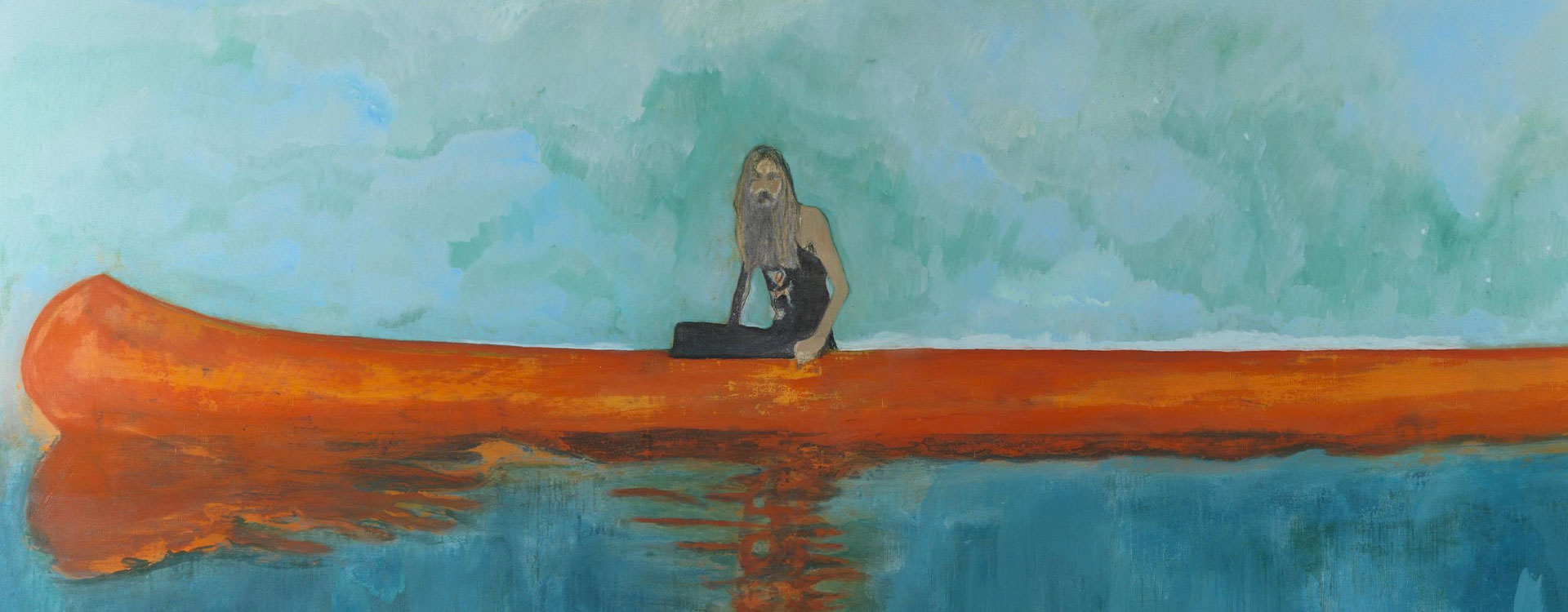
Focus on… “100 Years Ago (Carrera)” by Peter Doig
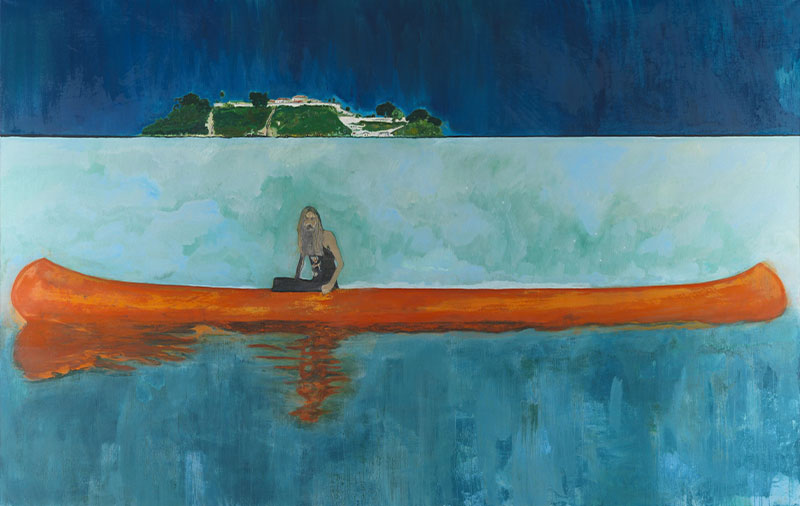
Painted in 2001, this monumental work (measuring an impressive 229 × 359 cm) from the Centre Pompidou collection unfolds like a landscape of the mind. It draws the eye in, holds it for a moment, then gently unsettles it. A solitary figure sits in a canoe, gliding across the water towards an island. The sky, the water and the dark mass of land seem almost motionless. And yet nothing here is quite as it appears. Before long, the image begins to dissolve, as though it belonged less to the visible world than to the realm of memory.
The motif of this iconic painting is also its subject: a drift through a boundless space that is at once pictorial and temporal. Drawing on his own memories, Peter Doig invites us to explore the murky waters of memory and carries us back to the dawn of modernity.
Angela Lampe, art historian and curator at Centre Pompidou
A Scene That Eludes Us
What strikes the viewer first is the painting’s silence. There is nothing anecdotal about it, nothing spectacular, no clearly defined narrative. All we see is a slow, almost suspended movement. The canoe glides forward, yet its point of departure and destination remain unknown. The island appears both near and distant. Time itself seems to thicken.
This sense of drifting lies at the heart of the work. The space opens up, yet resists measurement. Gradually, a feeling emerges of slipping between different eras, different memories and different images.
Painting from Images
Peter Doig was born in Edinburgh, Scotland, in 1959. He grew up between Trinidad, Canada and London, where he studied at the Chelsea School of Art. Since 2002 – just a year after completing this painting – he has lived and worked in Trinidad. More than a mere setting, the island, which runs throughout his work, functions as a mental landscape.
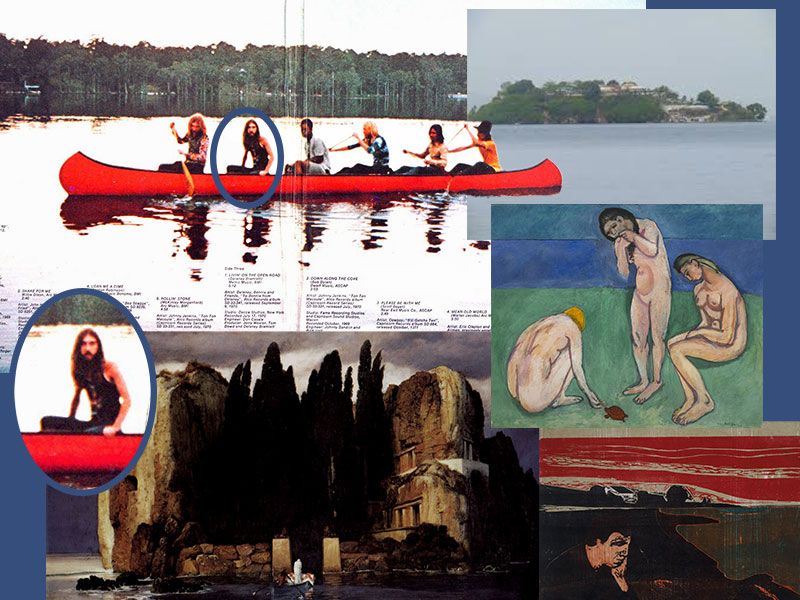
In 100 Years Ago (Carrera), everything begins there – more specifically with the prison island of Carrera, off the coast of Trinidad, which Doig copied from a photograph. Other references come into play: the cover of an album by the American Southern rock band The Allman Brothers Band, whose bassist, Berry Oakley – bearded, dishevelled and cast in the guise of a modern-day Robinson Crusoe – appears alone in the large canoe, a recurring motif in the artist’s work.
The painting’s subtle gradations of green and blue recall Henri Matisse’s Les Baigneuses à la tortue (Bathers with a Turtle, 1907–08), while the dreamlike atmosphere of the landscape draws on Arnold Böcklin’s Die Toteninsel (Isle of the Dead, 1880–86), as well as on certain works by the Norwegian Expressionist painter Edvard Munch. A master of landscape, Doig never paints directly from nature.
A master of landscape, Doig never paints directly from nature.
The work does not reproduce a single image so much as layer several images upon one another. Personal memories, popular visual culture, echoes from the history of art—this vast canvas presents a recomposed space, shaped by a multitude of geographical and biographical experiences that are at once vividly specific and elusive, and suffused with a strange melancholy. Doig does not seek to choose between these references. Instead, he allows them to coexist, as though painting were the very place where disparate layers of experience can overlap without ever settling into a fixed form. ◼
Related articles
In the calendar

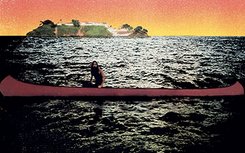
Peter Doig, 100 Years Ago (Carrera), 2001
Oil on canvas, 229 × 359 cm
© Peter Doig. All Rights Reserved, DACS / ADAGP, Paris
Photo © Centre Pompidou
Henri Matisse, Les Baigneuses à la tortue (Bathers with a Turtle), 1907–08
Oil on canvas, 179 × 220.3 cm
Saint Louis Art Museum, Missouri
Arnold Böcklin, L'Île des morts (Isle of the Dead), 1886
Oil on panel, 80 × 150 cm
Museum der bildenden Künste, Leipzig
Photograph from the album Duane Allman: An Anthology, November 1972
Edvard Munch, Evening. Melancholy I, 1896
Woodcut, 41.1 × 55.7 cm
Munch Museum, Oslo