The Secret History of Henri Matisse’s “Blue Nudes”
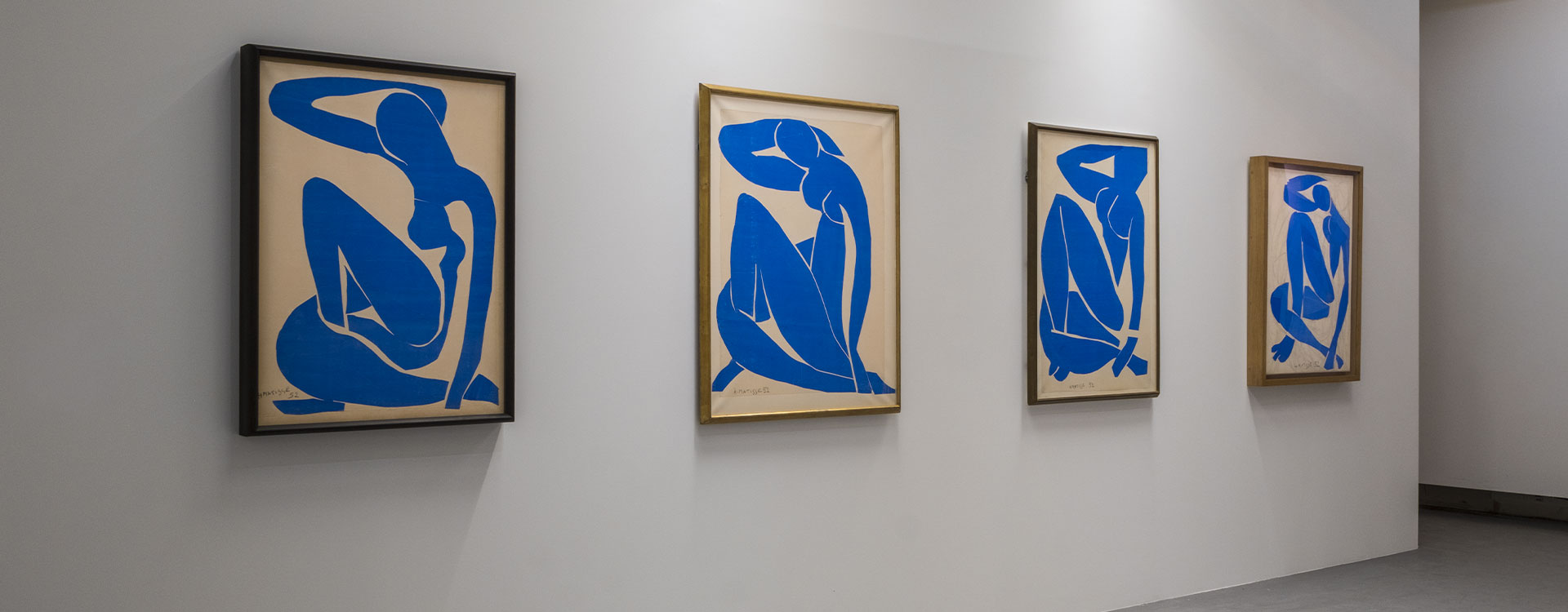
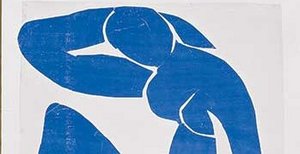
Blue against white, arms flung overhead, legs tucked in: the unmistakable silhouette of Matisse’s Blue Nude is so deeply embedded in our visual culture that it feels almost like a logo. Yet the story behind it – and the nuances of the work itself – remain surprisingly little known. In fact, it belongs to a series of four monumental compositions, each created in 1952 and measuring between 102 and 112 cm high, using the technique that came to define the artist’s final years: gouache-painted paper, cut out and mounted on canvas.
For all its apparent simplicity, the process was born of necessity. In 1941, Matisse’s life changed abruptly. At the height of his career, the artist once dubbed ‘the painter of happiness’ was diagnosed with colon cancer. He was 72. After surviving a major operation – and escaping death, as he liked to say, ‘by an Angora cat’s whisker’ – he was left wheelchair-bound and advised to avoid the solvents traditionally used in painting. Turpentine gave way to Linel, an ultra-fine gouache that he brushed across whole sheets of paper before cutting into them with scissors. Colour became matter: something to carve, shape and release, almost like a sculptor working directly in stone. ‘Cutting directly into colour reminds me of a sculptor’s direct carving,’ Matisse said in 1947, as the public discovered the plates of Jazz, his artist’s book.
Cutting directly into colour reminds me of a sculptor’s direct carving.
Henri Matisse
Until then, he had mostly used the technique behind the scenes, as a way of working through space and gaining control over large-scale compositions. It was a largely invisible method, first explored in the 1930s for The Dance, commissioned by the Barnes Foundation, and one he returned to intermittently – notably in the stained-glass windows for the Dominican Chapel in Vence. With the four Blue Nudes of 1952, however, that working method came fully into view, asserting itself as an art form in its own right.
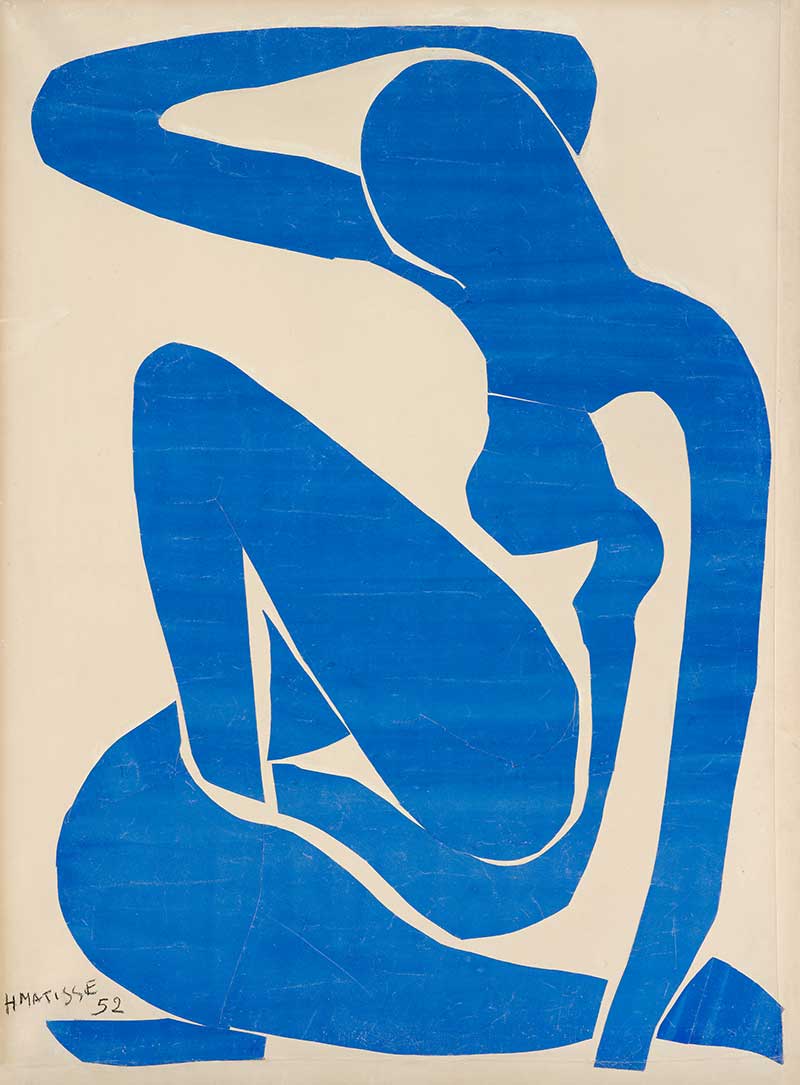
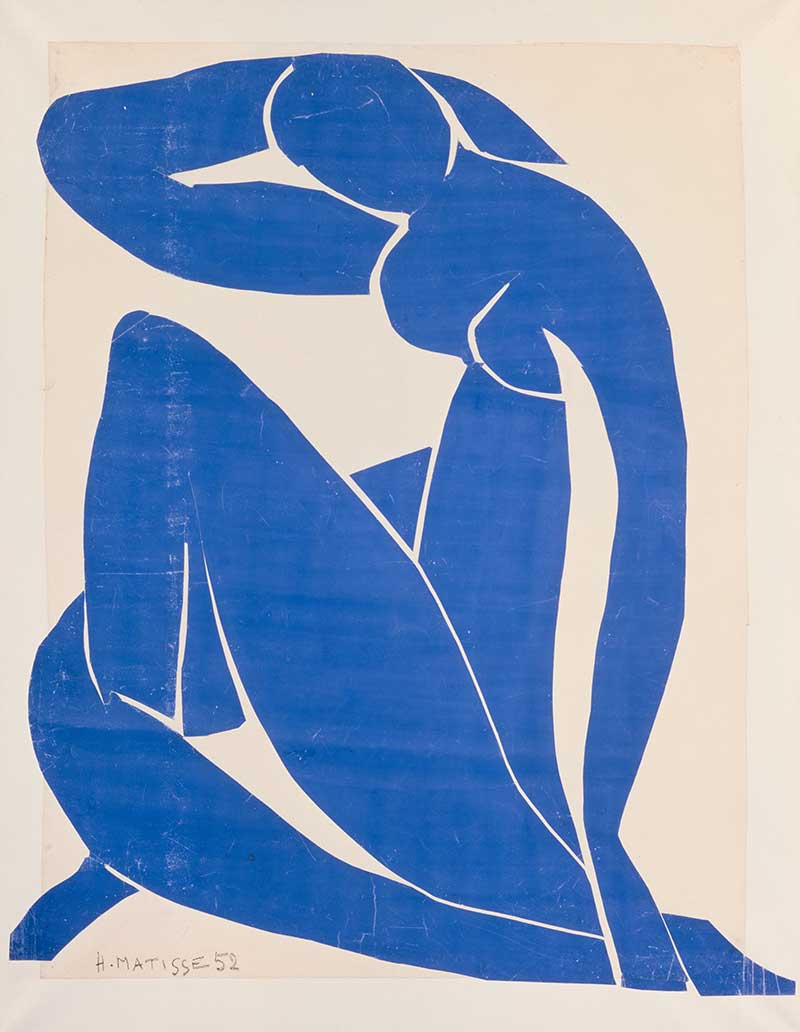
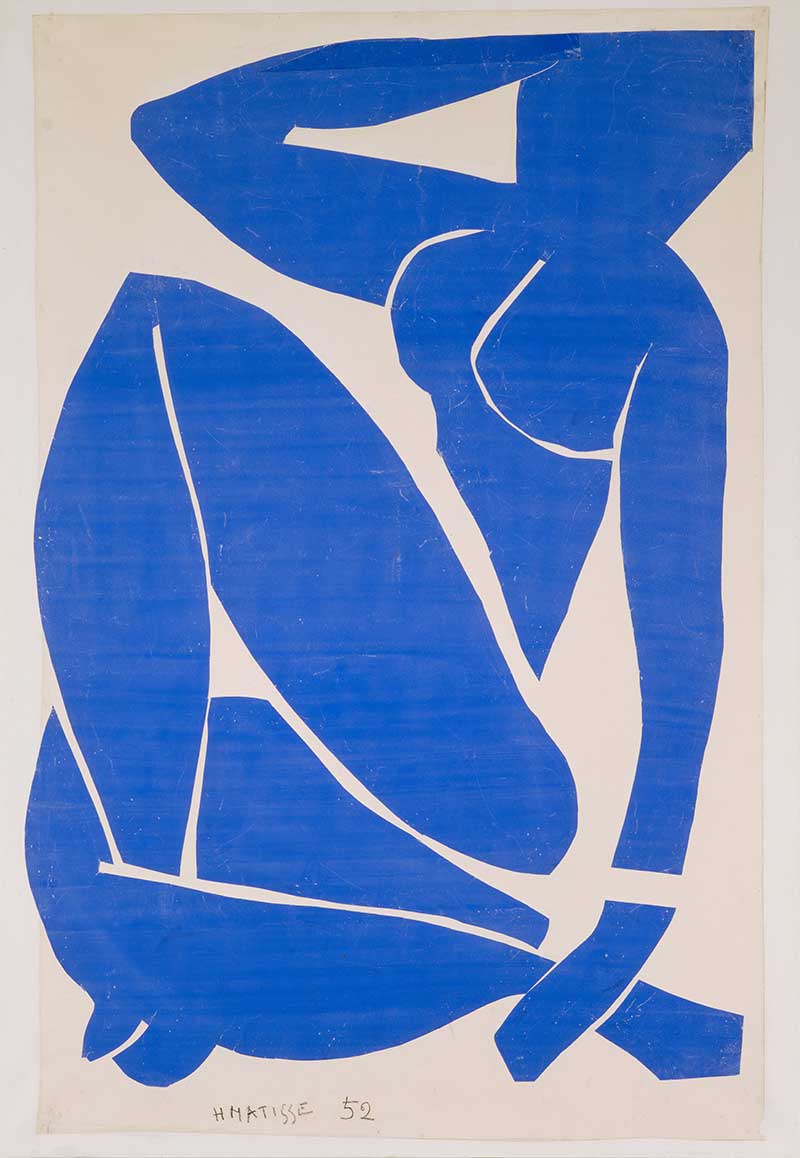
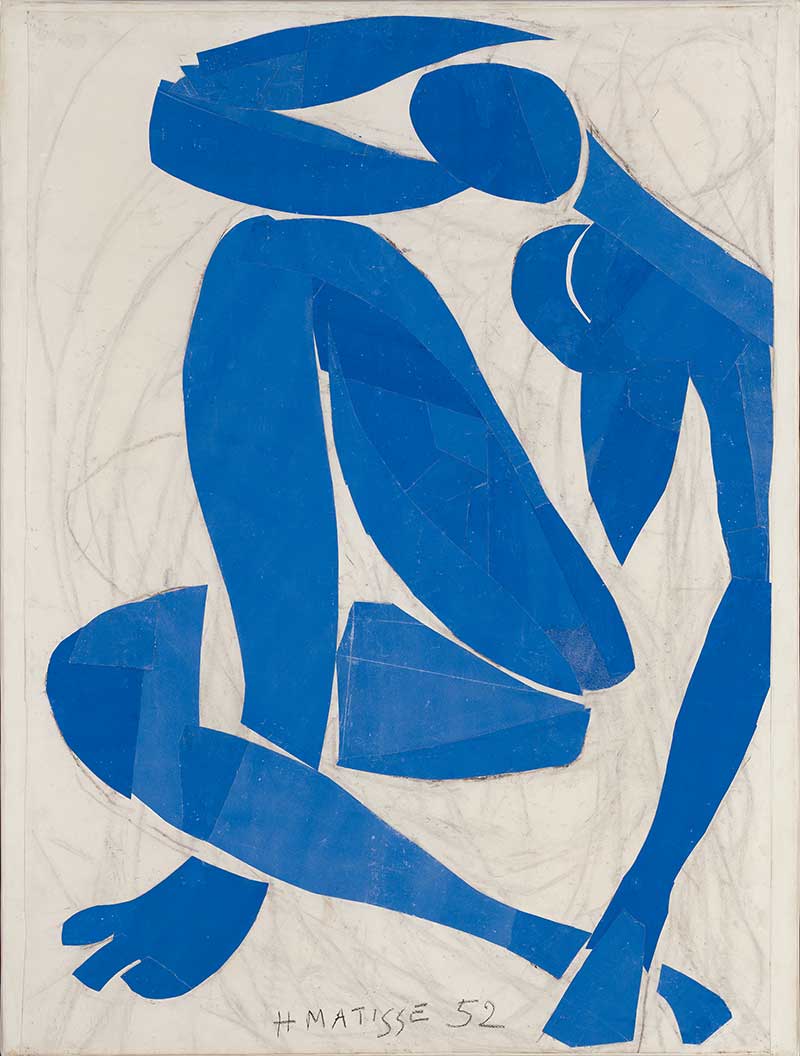
On a monumental scale, against a crisp white ground, a blue female figure comes into focus. But for all their family resemblance, these works might almost invite a game of spot the difference: from one canvas to the next, almost nothing is exactly the same. The dimensions shift, the blue varies, the pose changes, the execution unfolds at a different pace. Depending on the work, the figure appears fuller or more slender, more curved, more compact or more elongated.
That is how Nu bleu I, Nu bleu II and Nu bleu III were made: one after another, each in the space of a few hours. Lydia Delectorskaya, one of Matisse’s last models and closest collaborators, later recalled the process in her writings: ‘Each on a different day […] in one stroke, with a single movement of the scissors, in ten minutes or fifteen at most.’
Not so Nu bleu IV, which occupies a singular place within the series: it is both the work with which Matisse began and the one through which he brought the cycle to a close. It was also the piece to which he devoted the greatest number of sessions. Unlike the others, its ground is marked by charcoal traces, recording the successive positions of the gouache-painted and cut-paper elements. Matisse kept shifting them, again and again, until the arrangement felt right and the composition could finally be fixed.
As Claudine Grammont, curator of the exhibition “Matisse, 1941–1954”, explains, ‘the work is conceived through a myriad of cut gouaches that build the figure. Each time the artist moves an element, the charcoal line subtly alters the contour of the space allotted to it, knowing that within this rectangular field the voids are just as important as the solids.’ Indeed, it is within those intervals of empty space that the female figure finds its movement, suggests the articulations of its anatomy and gains its sense of volume. Each of the nudes, Grammont adds, possesses a sculptural force ‘capable of holding the wall, like a caryatid’.
And when caryatids come into play, what could be more natural than to invoke architecture? For his gouaches découpées, Matisse approached these surfaces according to the ‘law of the frame’, a principle drawn from Romanesque art, in which a figure is inscribed within a predetermined space. Here, a rectangle: ‘a multiplicity of papers are adjusted, and contours traced. In this way, the Nu bears visible witness to the time the work took to be made,’ notes Claudine Grammont.
By fitting these elements within the bounds of the sheet, Matisse was seeking the overall harmony of the composition. The result gives these seemingly classical nudes a remarkable fluidity. They evoke some of Matisse’s key influences – Paul Gauguin, Paul Cézanne and the sculptor Aristide Maillol among them. As for the blue, it has a warmth and magnetism that calls to mind both the artist’s 1930 trip to Tahiti and the light of the Hôtel Régina in Nice. It is to that southern light, in fact, that we owe this absinthe blue – immersive and utterly distinctive – which gives the series its singularity.
With Matisse, colour creates space, and this blue runs through almost the whole of 1952, and beyond.
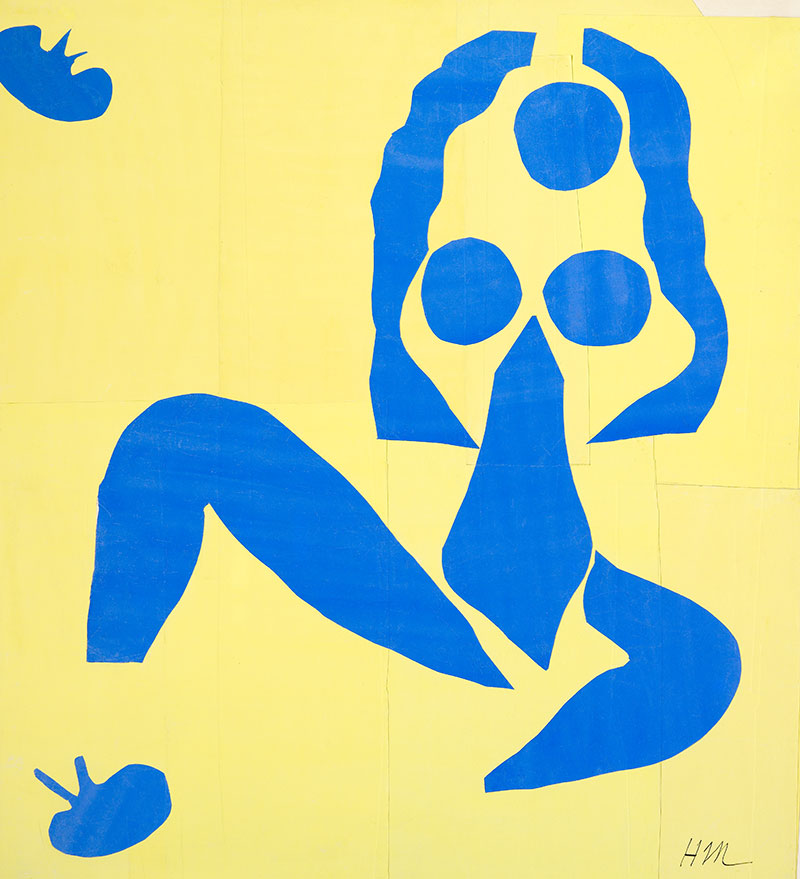
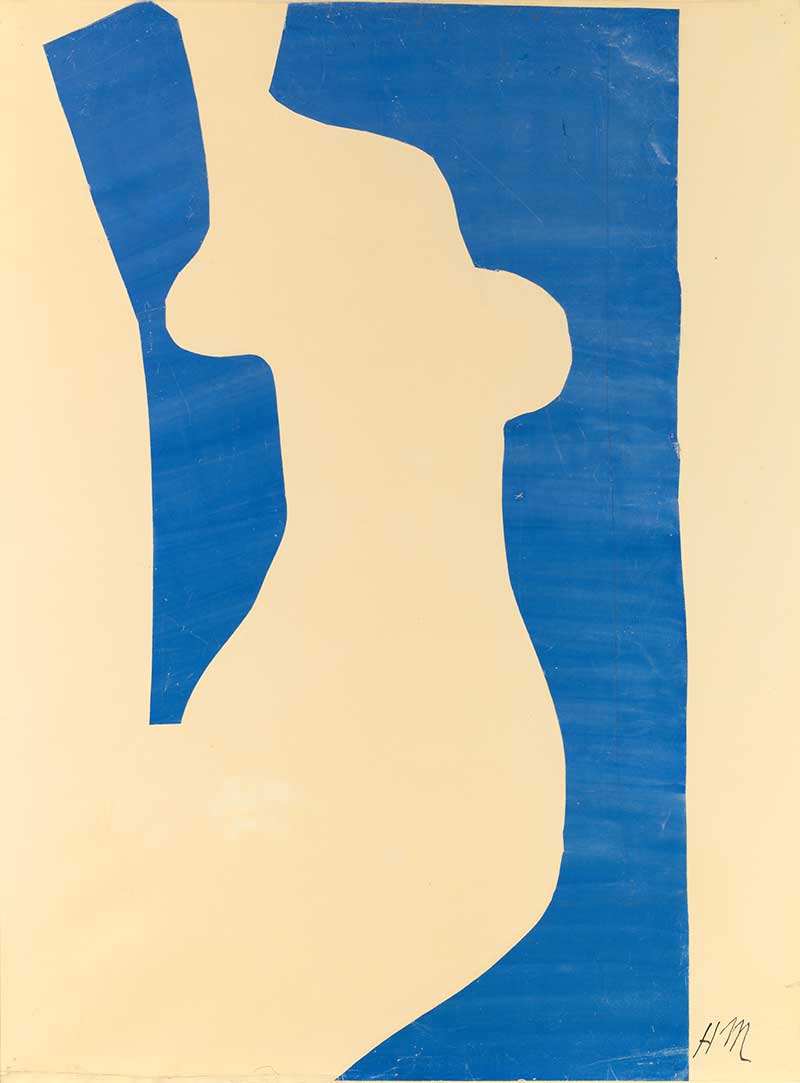
With Matisse, colour creates space, and this blue runs through almost the whole of 1952, and beyond. It is the blue of the swimmers in the aquatic ballet of La Piscine (1952), now in the collection of MoMA in New York. If its absence from the Grand Palais exhibition is keenly felt, it is offset by the blue of the Acrobates, whose supple silhouette follows a brushstroke as acrobatic as it is assured, dipped by Matisse into ink. The work is being shown in France for the first time, as are Vénus – a figure emerging in negative between two sheets of gouache-painted paper – and Femme à l’amphore, both on loan from the National Gallery of Art in Washington. Then there is the wryly humorous Nu bleu, la grenouille, lent by the Fondation Beyeler and not seen in France since 1970. As for the splendid Nu bleu aux bas verts, from the Fondation Louis Vuitton, it brings flashes of green and fuchsia into the blue. The four crouching nus bleus – the most celebrated of them all – have been reunited thanks to exceptional loans: Nu bleu I comes from the Fondation Beyeler in Switzerland, Nu bleu IV from the Musée Matisse in Nice, while Nu bleu II and Nu bleu III belong to the collection of the Centre Pompidou.
No conclusion would be complete without returning to the first of them all: the celebrated Nu bleu (Souvenir de Biskra), painted in 1907. Quite logically absent from this exhibition devoted to the master’s final years before his death in 1954, Souvenir de Biskra was also, rather mysteriously, referred to by Matisse as ‘Tableau numéro IV’. ‘It is obvious that when he painted this series, he must have had the 1907 work in mind – now in the Baltimore Museum – the pose is quite similar,’ Claudine Grammont points out. ‘It was painted in memory of the oasis of Biskra, in Algeria. To my mind, it suggests a far more conceptual approach to painting in Matisse,’ the curator adds.
I like modelling as much as I like painting – I have no preference. The quest is the same, and when one medium tires me, I turn to the other.
Henri Matisse
This painting, at once figurative and pared back, was in fact the transposition of a terracotta sculpture made by the artist, inspired by Alexandre Cabanel and accidentally broken. When it was shown in 1907, it caused a scandal: viewers were shocked by the model’s gender ambiguity. Above all, the work reminds us that, for Henri Matisse, painting and sculpture were inseparable: ‘I like modelling as much as I like painting – I have no preference. The quest is the same, and when one medium tires me, I turn to the other.’ ◼
Related articles
In the calendar
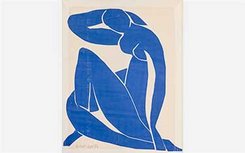
Henri Matisse, Nu bleu I, 1952
Cut-out gouache on paper, mounted on canvas, 106.3 × 78 cm
Fondation Beyeler, Riehen/Basel, Beyeler Collection / Photo: Robert Bayer
Henri Matisse, Nu bleu II, 1952
Cut-out gouache on paper, mounted on canvas, 103.8 × 86 cm
Centre Pompidou, Paris
Photo © Centre Pompidou, Mnam-Cci/Dist. GrandPalaisRmn
Henri Matisse, Nu bleu III, 1952
Cut-out gouache on paper, mounted on canvas, 112 × 73.5 cm
Centre Pompidou, Paris
Photo © Centre Pompidou, Mnam-Cci/Dist. GrandPalaisRmn
Henri Matisse, Nu bleu IV, 1952
Charcoal and cut-out gouache on paper, mounted on canvas, 103 × 74 cm
Gift of Madame Jean Matisse to the French State for deposit at the Musée Matisse Nice, 1978, Musée d’Orsay, Paris (inv. D.78.1.57 / RF 36789)
Musée Matisse Nice
Photo © François Fernandez
Henri Matisse, Nu bleu, la grenouille, 1952
Cut-out gouache on paper, mounted on canvas, 141 × 134.5 cm
Fondation Beyeler, Riehen/Basel, Beyeler Collection / Photo: Robert Bayer
Henri Matisse, Vénus, 1952
Cut-out gouache on white paper, laid down on paperboard, 101.2 × 76.2 cm
National Gallery of Art, Washington